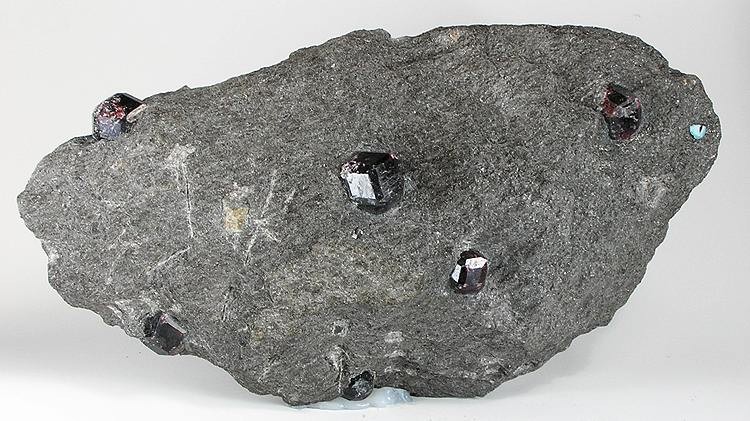
Almandine Garnet
Granato Almandino
Fe₃Al₂(SiO₄)₃ Properties
- Category
- Gem
Almandine garnet is an iron and aluminum silicate that forms cubic crystals with red-violet hues, among the most widespread and appreciated members of the garnet family. Its hardness of 7.5 on the Mohs scale makes it ideal for jewelry and distinguishes it by its characteristic dark red, almost wine-colored hue, which has made it renowned since ancient times.
Almandine garnet (Fe₃Al₂(SiO₄)₃) is the most abundant member of the pyrosilicate garnet series, typically forming in medium to high-grade metamorphic rocks such as iron-rich micaschists and gneisses. Its perfect cubic crystals and intense red color, resulting from the presence of divalent iron (Fe²⁺), make it a highly sought gemstone in the global gemological market. Unlike other garnets, almandine maintains good transparency even in gem-quality specimens, although most natural crystals exhibit inclusions and color zoning. Historically, the term "almandine" derives from the city of Alabanda in Turkey, where these crystals were traded during the Middle Ages. Today, the principal gem deposits are found in India (Rajasthan), Sri Lanka, Brazil, and Madagascar, with Indian specimens dominating the market in both quantity and quality.
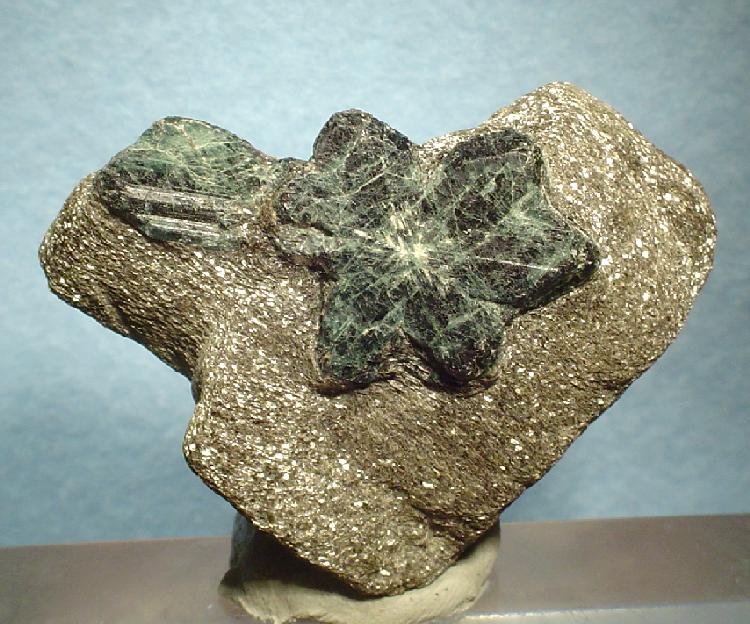
Almandine garnet crystallizes in the cubic system, space group Ia3d, with lattice parameter a = 11.526 Å. The structural formula is Fe₃Al₂(SiO₄)₃, where iron occupies octahedral sites (coordination 6) and aluminum minor octahedral sites, while silicon is in tetrahedral coordination. Density: 3.95–4.20 g/cm³; refractive index: nD ≈ 1.760–1.820 (isotropic); Mohs hardness: 7.0–7.5. The UV-Vis absorption spectrum shows characteristic bands in the red (~500 nm) and blue (~400 nm) regions due to d-d transitions of Fe²⁺. Pleochroism is absent (cubic symmetry). Under long-wave ultraviolet light, almandine may display weak red-orange fluorescence. Polarization microscopy reveals the optical isotropy typical of cubic minerals. Raman spectroscopic analysis confirms characteristic vibrational bands of silicates: ν₁(SiO₄) ≈ 920 cm⁻¹. Common inclusions: magnetite, ilmenite, quartz, feldspar; magnetite inclusions can impart asterism in rare cases. Congruent melting temperature: ~1260 °C.
Mining localities
- Rajasthan, India (gemme di qualità commerciale, rosso-violaceo intenso)
- Sri Lanka (Ceylon; gemme trasparenti, colore rosso-bruno)
- Brasile, Minas Gerais (cristalli di buona qualità, rosso profondo)
- Madagascar (gemme di recente scoperta, qualità variabile)
- Boemia, Repubblica Ceca (giacimenti storici, cristalli su scisto)
- Alpi Orientali, Austria e Svizzera (metamorfiti di alta quota)
- Norvegia, Svezia (scisti metamorfici precambriani)
- Carolina del Nord e del Sud, USA (gneiss granitici)
Frequently Asked Questions
How do you identify an authentic almandine garnet?
Authentic almandine garnet displays a deep red or red-violet color, a hardness of 7.5 on the Mohs scale (resistant to knife scratches but not to diamond), and natural crystals with cubic or dodecahedral form. A distinctive feature is its high specific gravity (3.95-4.15) and the absence of particular optical effects like pronounced asterism or pleochroism, which differentiate it from other garnet varieties.
What is the difference between almandine garnet and ruby?
Almandine garnet is an iron and aluminum silicate (Fe₃Al₂(SiO₄)₃) with hardness 7.5, while ruby is aluminum oxide (Al₂O₃) with hardness 9, making it significantly harder. Almandine garnet tends to have a darker and more violet-red color, while ruby displays brighter and more vivid reds; furthermore, ruby is much rarer and more expensive than almandine garnet.
Where are the most important deposits of almandine garnet found?
The main world deposits of almandine garnet are located in India (particularly in the state of Kerala), Madagascar, Brazil, and the United States (especially in New York and North Carolina). India remains the largest producer and supplier of jewelry-quality almandine garnets, with crystals often extracted from iron and aluminum-rich metamorphic rocks.
How much does almandine garnet cost and what factors influence the price?
The price of almandine garnet typically ranges from €10 to €100 per carat for jewelry-quality specimens, making it far less expensive than rubies. Factors influencing the price include the intensity and purity of the red color, transparency, absence of inclusions, crystal size, and geographical origin, with Indian and Malagasy garnets generally more prized than those from other deposits.
Entry generated with Claude API (Anthropic) on data extracted from Mindat, RRUFF and Wikipedia. Not yet reviewed by a human expert. Verify data against original sources before citing in formal work.