Amethyst
Ametista
SiO₂ Properties
- Color
- Violet, pale violet, pink-violet
- Luster
- Vitreous
- Density
- 2.65 g/cm³
- Category
- Gem
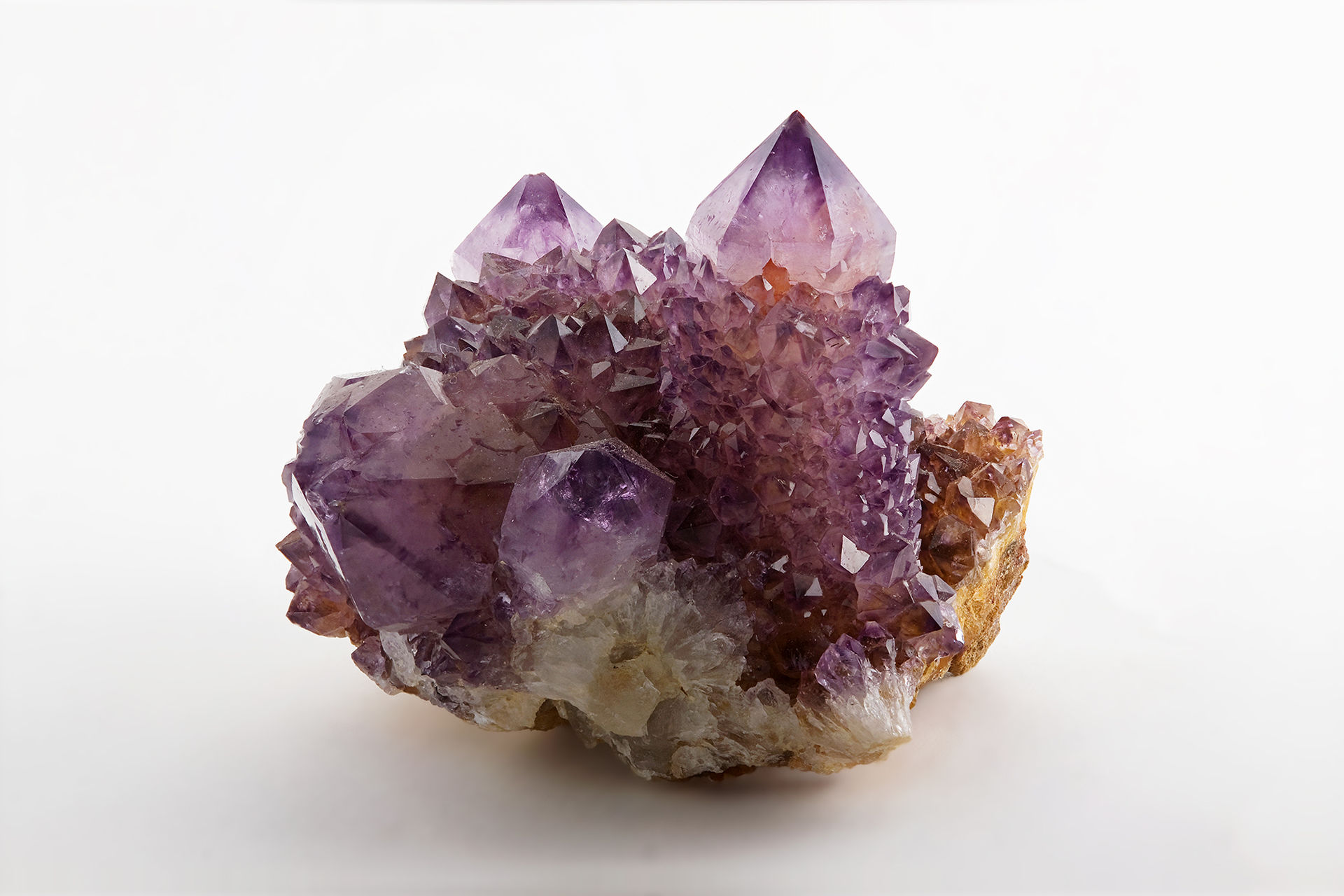
Amethyst is a violet variety of quartz, colored by the presence of iron and natural irradiation within the crystal lattice. It is the most prized variety of quartz and historically the most used in jewelry, from Roman imperial crowns to medieval episcopal rings.
The violet color derives from the presence of iron (Fe⁴⁺) substituting for silicon in the crystal lattice, combined with natural irradiation. The color intensity varies from pale pink-violet to deep violet. Heat can decolorize amethyst or transform it into citrine.
The bicolor variety with alternating zones of amethyst and citrine within the same crystal is called ametrine and is exclusive to the Anahi mine in Bolivia.
Belongs to the quartz group, trigonal crystal system with a structure of SiO₄ tetrahedral chains. The refractive index is 1.544–1.553, with birefringence of 0.009. Characteristic inclusions include tiger stripes—alternating growth zones—and small crystals of hematite or goethite.
Mining localities
- Minas Gerais, Brasile (principale produttore mondiale)
- Uruguay
- Zambia
- Madagascar
- Magaliesburg, Sud Africa
Frequently Asked Questions
How is amethyst formed and why is it purple?
Amethyst forms when quartz (SiO₂) containing iron traces in its crystal lattice is exposed to natural radiation underground, producing its characteristic purple color. This process can take millions of years within geodes and rock cavities. The intensity of color depends on the amount of iron present and the level of radiation exposure received.
How can you recognize real amethyst from imitation?
Authentic amethyst has a hardness of 7 on the Mohs scale (not scratched by a knife) and displays color varying from pale lilac to deep purple, often more intense toward the crystal points. Glass imitations will be softer, often show air bubbles under magnification, and have uniformly distributed color throughout.
Where is amethyst found in the world and how much does it cost?
The main amethyst deposits are found in Brazil (Rio Grande do Sul), Uruguay, Madagascar, Zambia, and Namibia. Prices vary considerably from €1-5 per carat for common specimens to €20-50+ per carat for superior gem-quality stones with intense color and excellent clarity.
Why does amethyst fade in sunlight and how should you store it?
Amethyst fades with prolonged UV light exposure because ultraviolet rays alter the iron atoms in the crystal lattice responsible for its color. To preserve it, keep the stone in a dark box away from direct sunlight and intense heat sources, and avoid wearing it during prolonged outdoor activities.
Entry generated with Claude API (Anthropic) on data extracted from Mindat, RRUFF and Wikipedia. Not yet reviewed by a human expert. Verify data against original sources before citing in formal work.