Ammonite
Ammonite
CaCO₃ Properties
- Category
- Fossil
The ammonite is the fossilized shell of an extinct marine cephalopod, composed primarily of aragonite (CaCO₃), which lived from the Devonian through its extinction at the end of the Cretaceous approximately 66 million years ago. Its logarithmic spiral structure and internal chambered septa make it one of the most recognizable and fascinating fossils in Earth's history.
Ammonites were marine cephalopod mollusks that dominated the paleozoic and mesozoic oceans, becoming extinct alongside the dinosaurs at the Cretaceous-Paleogene boundary. Their shell, originally composed of aragonite (a metastable form of CaCO₃), exhibits a spiral chambered structure: each new chamber was added as the animal grew, while previous chambers were filled with gas to control buoyancy. This biological architecture represents an extraordinary example of evolutionary optimization.
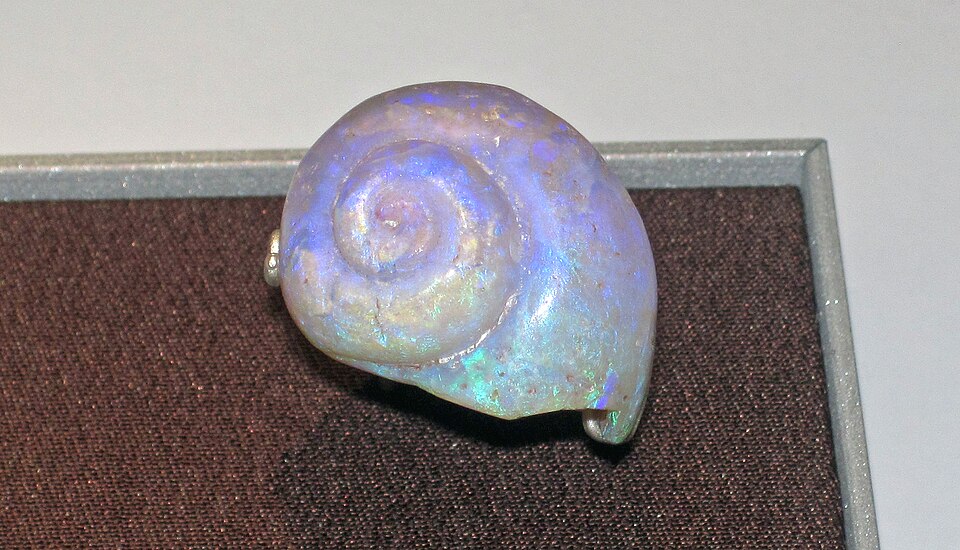
Ammonite fossilization typically occurs in marine sedimentary environments where the shell is rapidly buried by mud or sand, preserving microscopic details such as sutures (the junction lines between chambers) and sometimes even traces of original iridescent mother-of-pearl. Ammonites are index fossils of enormous stratigraphic value: they enable paleontologists to date rock strata and correlate sedimentary sequences across different continents. Exceptional specimens, particularly those with recrystallized opal or pyrite, are highly sought by collectors and command considerable prices in specialized markets.
Ammonites are heteromorphic cephalopod mollusks characterized by shells with chambered septa and sutures of varying complexity (ranging from simple ammonitic form to the complex ceratitoidal and ammonitic sensu stricto forms). The original composition is aragonite (orthorhombic CaCO₃), although diagenesis may convert it to calcite (trigonal). Hardness ranges from 3-4 on the Mohs scale for aragonite, with relative density of 2.93-2.95 g/cm³.
Morphologically, the shell follows a logarithmic spiral describable by Moseley's formula, with variable involution and species-specific ornamentation (ribs, tubercles, spines). The chambered septa are separated by imperforate calcitic septa, while the siphuncle (connecting tube) passes centrally through the chambers. The final unseptate chamber (body chamber) housed the living animal.
From a paleontological perspective, ammonites are index fossils of exceptional biostratigraphic value, enabling precise chronological subdivisions of the Devonian (359-359 Ma), Carboniferous (359-299 Ma), Permian (299-252 Ma), Triassic (252-201 Ma), Jurassic (201-145 Ma), and Cretaceous (145-66 Ma). Their extinction at the K-Pg boundary coincides with the Chicxulub asteroid impact. Exceptional specimens with secondary mineralization (opal, pyrite, marcasite, limonite) are the subject of specialized gemmological and paleontological research.
Mining localities
- Dorset, Inghilterra (Regno Unito)
- Lyme Regis, Inghilterra (Regno Unito)
- Württemberg, Germania
- Alpi Apuane, Toscana (Italia)
- Marche, Italia
- Madagascar
- Marocco
- Alberta, Canada
- Wyoming, Stati Uniti d'America
- Giappone
Frequently Asked Questions
How is an ammonite fossil formed?
An ammonite forms when the aragonite (CaCO₃) shell of an extinct marine cephalopod becomes buried by sediments and undergoes mineralization over millions of years. During fossilization, surrounding minerals penetrate the porous shell structure, replacing or filling the internal septate chambers and preserving the characteristic logarithmic spiral. This process has kept ammonites intact from the Devonian period until the Cretaceous extinction, approximately 66 million years ago.
How much does an ammonite cost and where are they found?
Ammonite prices range from 10-50 euros for small, lower-quality specimens up to hundreds of euros for large, well-preserved fossils, with rare specimens reaching thousands of euros. They are found primarily in deposits in Germany (Posidonia Shale), France (Jurassic), England (Dorset and Lyme Regis), and Canada, as well as in paleontological collections and specialized mineral dealers.
How can you identify a genuine ammonite from a fake one?
A genuine ammonite displays a well-defined symmetrical spiral with visible septate chambers in cross-section, natural surface texture, and color variations due to aragonite (CaCO₃) mineralization over time. Modern counterfeits often show overly perfect symmetry, absence of natural microfractures, artificially uniform coloring, and lack of correct specific weight; microscopic examination reveals the absence of the genuine fossil's characteristic crystalline structures.
What is the difference between an ammonite and a nautilus?
Both ammonites and nautili are marine cephalopods with aragonitic (CaCO₃) shells divided into septate chambers, but the ammonite went extinct 66 million years ago while the nautilus still exists today. Ammonites displayed tighter spirals and much greater shape variety, while the modern nautilus has a more open spiral and simpler structure; additionally, ammonites had straight tentacles (ammonitids) while nautilus has fleshy tentacles.
Entry generated with Claude API (Anthropic) on data extracted from Mindat, RRUFF and Wikipedia. Not yet reviewed by a human expert. Verify data against original sources before citing in formal work.