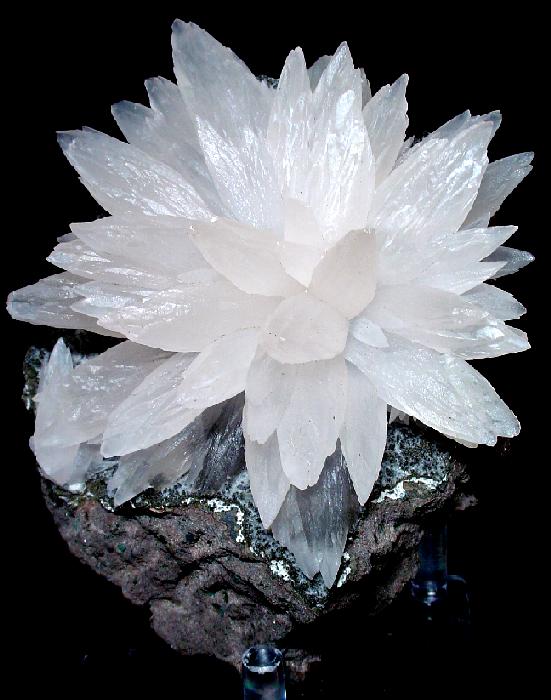
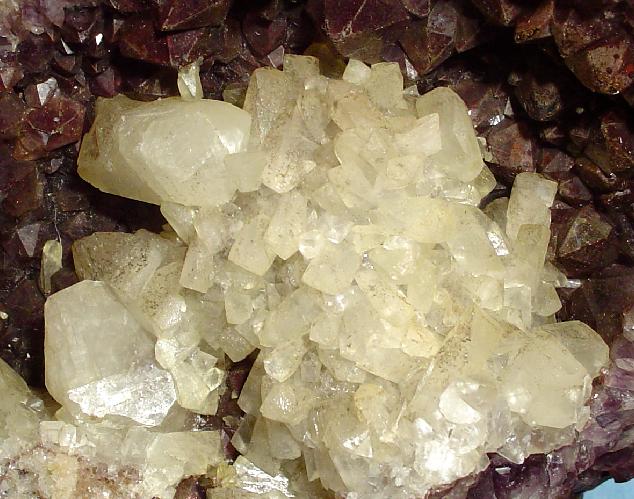
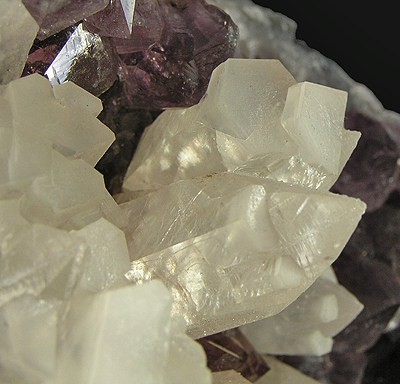
Calcite
Calcite
CaCO₃ Properties
- Category
- Mineral
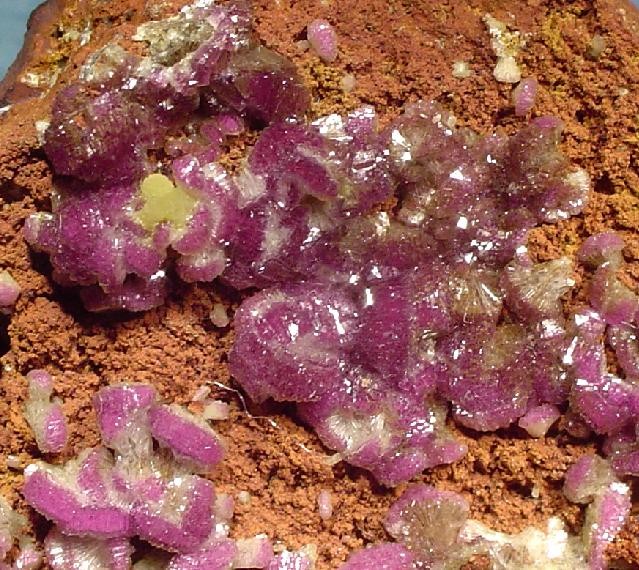
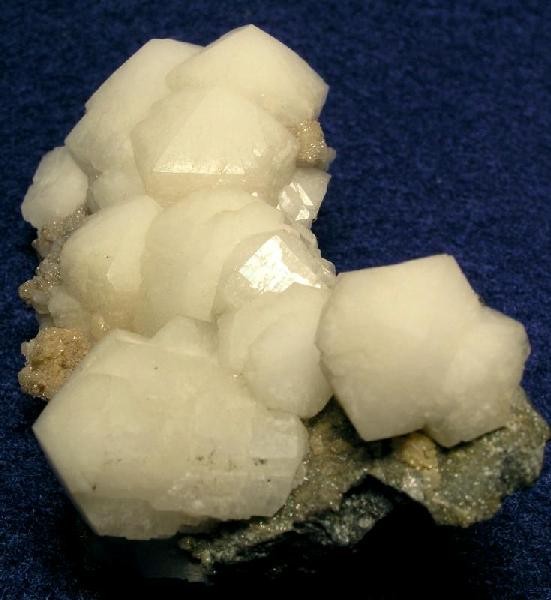
Calcite is the most common mineral form of calcium carbonate (CaCO₃), forming transparent or colored crystals and constituting the foundation of rocks such as marble and limestone. It is so soft (hardness 3 on the Mohs scale) that a knife scratches it easily, and it reacts effervescently with dilute acids.
Calcite is the stable polymorph of CaCO₃ at ordinary temperatures and pressures, crystallizing in the trigonal system (space group R3̄c) with extremely variable crystal habit: from acute rhombohedra to prisms, scalenohedra, and complex forms. Its layered structure of calcium and carbonate ions explains the perfect rhombic cleavage and marked optical birefringence (ordinary refractive index nω ≈ 1.658, extraordinary nε ≈ 1.486), properties that make it invaluable in optics and crystallography.
It forms in sedimentary environments as a precipitate from carbonate-rich waters (mollusc shells, corals, oolites), in metamorphic rocks (marbles), in hydrothermal deposits, and as a secondary mineral in oxidation zones. Frequently associated with dolomite, aragonite, fluorite, and quartz. Calcite is ubiquitous on Earth: it constitutes 50% of sedimentary limestone and represents an extraordinary archive of paleoclimatic information through stable isotope analysis of oxygen and carbon.
Calcite — CaCO₃, trigonal system, space group R3̄c, a = 4.989 Å, c = 17.062 Å, Z = 6. Hardness 3 Mohs, density 2.71 g/cm³. Perfect cleavage along 10.4 (rhombohedral). Refractive indices: nω = 1.6584, nε = 1.4864 (birefringence Δn = 0.172, negative). Rhombic cleavage angle ~101.5°. Solubility in dilute HCl at room temperature with effervescence. Variable fluorescence (often blue under long-wave UV). IR spectroscopy: characteristic carbonate absorption at 1420–1450 cm⁻¹ (asymmetric stretching), 875 cm⁻¹ (out-of-plane bending). Thermal analysis (TGA): CO₂ loss at 825–900 °C. Ideal composition: CaO 56.03%, CO₂ 43.97%. Common trace elements: Mg, Fe, Mn, Sr, Ba; in gem varieties, Fe³⁺ imparts pink tones (rhodochrosite-like). Notable varieties: Iceland spar (optical transparency, birefringence), otoconia (auditory microcrystals), Iceland spar (historical optical variety).
Mining localities
- Cina — Guangxi, Yunnan (cristalli gemati blu e rosa)
- Messico — Chihuahua, Durango (cristalli trasparenti e colorati)
- Brasile — Minas Gerais (cristalli gialli e arancioni)
- Norvegia — Telemark (Iceland spar, varietà ottica)
- Svizzera — Vallese (marmi e cristalli in rocce metamorfiche)
- Italia — Trentino-Alto Adige, Piemonte (marmi e calcare fossilifero)
- Madagascar — cristalli rosa e blu di qualità gemologica
- Stati Uniti — New York, Ohio (fossili e ooliti)
- Spagna — Andalusia (calcite blu e verde)
Frequently Asked Questions
How do I recognize calcite and how do I distinguish it from other minerals?
Calcite is recognized by its very low hardness (3 on the Mohs scale), which allows a knife to scratch it easily, and by its effervescent reaction with dilute acids like hydrochloric acid. Calcite crystals are often transparent or slightly colored with characteristic geometric shapes (rhombohedra), and many varieties exhibit optical double refraction (birefringence).
Where is calcite found in nature and what are the main rocks containing it?
Calcite is one of the most abundant minerals on Earth and is found in sedimentary rocks such as limestone and marble, as well as in gypsum deposits and stalactites in caves. It forms primarily from the precipitation of calcium carbonate in marine, lacustrine, and underground environments, making it ubiquitous on nearly all continents.
What is the crystal structure of calcite and what physical properties characterize it?
Calcite has the chemical formula CaCO₃ and crystallizes in the trigonal (rhombohedral) system, forming crystals with characteristic three-axis symmetry. Its main properties include hardness 3, perfect cleavage along the rhombohedron, density of 2.71 g/cm³, and the famous birefringence that produces a double image when viewed in transparency.
What is calcite used for and what are its industrial applications?
Calcite is used in multiple industrial sectors: as raw material for the production of cement and quicklime, as a filler in paints and plastics, for the production of pure calcium carbonate, and as a soil acidity corrector in agriculture. It is also employed in metallurgy, glass production, and as a construction material in the form of decorative marble and limestone.
Entry generated with Claude API (Anthropic) on data extracted from Mindat, RRUFF and Wikipedia. Not yet reviewed by a human expert. Verify data against original sources before citing in formal work.