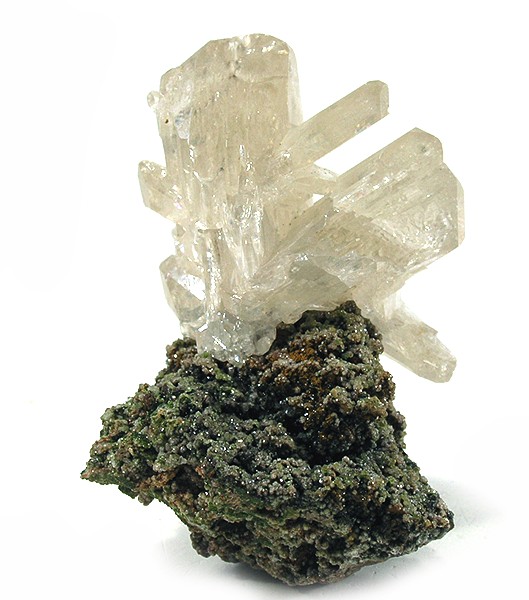
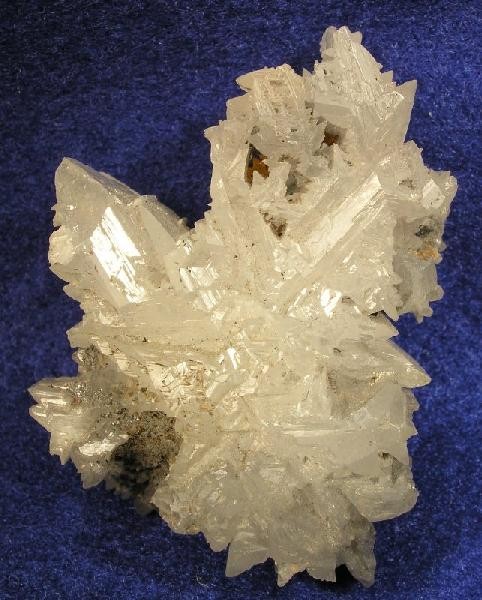
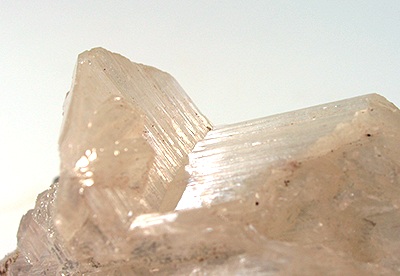
Cerussite
Cerussite
PbCO₃ Properties
- Category
- Mineral
Cerussite is a lead carbonate (PbCO₃) that forms from the superficial alteration of primary lead minerals in oxidized zones. It is an orthorhombic mineral characterized by crystals that are often tabular or acicular, sometimes colorless or white, with a adamantine luster that is very pronounced and makes it easily recognizable.
Cerussite is one of the most important secondary lead minerals from an economic and scientific perspective. It forms in the oxidation zone (or zone of supergene enrichment) of lead deposits, where percolating waters alter primary sulfides such as galena (PbS). The formation process involves the oxidation of lead and its combination with dissolved carbon dioxide, generating cerussite crystals that often associate with other secondary carbonates such as smithsonite (ZnCO₃) and malachite.
From a crystallographic point of view, cerussite belongs to the orthorhombic system with point group mmm, and presents a structure similar to that of aragonite. Crystals are frequently tabular according to the (010) plane, sometimes acicular, and can reach considerable dimensions in particularly rich deposits. Its adamantine luster is due to the high refractive index (n ≈ 1.80), which gives the crystals a characteristic brilliance similar to diamonds. The relatively low hardness (3–3.5 on the Mohs scale) and perfect cleavage along the (110) planes make the mineral fragile and suitable for collecting rather than industrial extraction.
Cerussite — PbCO₃. Crystal system: orthorhombic, space group Pnma (no. 62). Lattice parameters: a = 6.124 Å, b = 8.436 Å, c = 5.195 Å. Calculated density: 6.55 g/cm³. Mohs hardness: 3–3.5. Cleavage: perfect along (110), good along (021). Luster: adamantine. Color: colorless, white, gray, sometimes yellow or brown due to inclusions of iron oxides. Transparency: transparent to translucent. Refractive index: nα = 1.801, nβ = 1.804, nγ = 1.824 (birefringence = 0.023). Optic angle: 2V ≈ 9° (positive). Raman spectroscopy: characteristic bands at 1070 cm⁻¹ (symmetric C-O stretch), 1445 cm⁻¹ (asymmetric C-O stretch), 680 cm⁻¹ and 850 cm⁻¹ (out-of-plane bending). UV fluorescence: sometimes blue-white fluorescence under short-wave UV. Solubility: soluble in dilute nitric acid with effervescence. Typical mineral associations: galena, anglesite (PbSO₄), smithsonite, malachite, azurite, limonite. Formation: typical secondary mineral of the oxidation zones in lead-zinc deposits. Diagnostic character: the combination of adamantine luster, high specific gravity, perfect cleavage, and reaction with dilute nitric acid permits reliable identification.
Mining localities
- Tsumeb, Namibia
- Leadhills, Scozia, Regno Unito
- Matlock, Derbyshire, Inghilterra
- Touissit, Marocco
- Broken Hill, Nuovo Galles del Sud, Australia
- Coeur d'Alene, Idaho, Stati Uniti
- Laurion, Grecia
- Iglesias, Sardegna, Italia
- Bleiberg, Austria
- Mina Ojuela, Durango, Messico
Frequently Asked Questions
How do you recognize cerussite in nature and what are its main characteristics?
Cerussite (PbCO₃) is recognized by its brilliant adamantine luster and often tabular or acicular crystals, which are colorless or white. It is an orthorhombic mineral with relatively high density (6.5-6.6 g/cm³) that effervesces weakly in dilute hydrochloric acid. A simple identification test is the density test: cerussite is much heavier than common silicate minerals.
Where is cerussite found and how does it form?
Cerussite forms in oxidation zones (gossan) of primary lead deposits as a surface alteration product of galena and other lead minerals. It is commonly found in association with smithsonite, anglesite, and iron oxides in arid or semi-arid climates. Major deposits are located in Australia, Namibia, Kazakhstan, and Mexico.
What is the chemical formula of cerussite and what are its important physical properties?
The chemical formula of cerussite is PbCO₃ (lead carbonate), with an orthorhombic crystal system. It exhibits a hardness of 3-3.5 (Mohs scale), a density of 6.5-6.6 g/cm³, and sometimes shows UV fluorescence. Its adamantine luster and high specific gravity are diagnostic properties that distinguish it from other carbonates.
Is cerussite used as a commercial lead mineral and what is its economic value?
Cerussite is not currently a commercially significant lead mineral, as galena remains the primary ore exploited industrially. However, cerussite is sought by mineral collectors for the beauty of its crystals, especially museum-quality specimens, which can command considerable prices (from tens to thousands of euros). Its value is primarily collectible rather than industrial-economic.
Entry generated with Claude API (Anthropic) on data extracted from Mindat, RRUFF and Wikipedia. Not yet reviewed by a human expert. Verify data against original sources before citing in formal work.