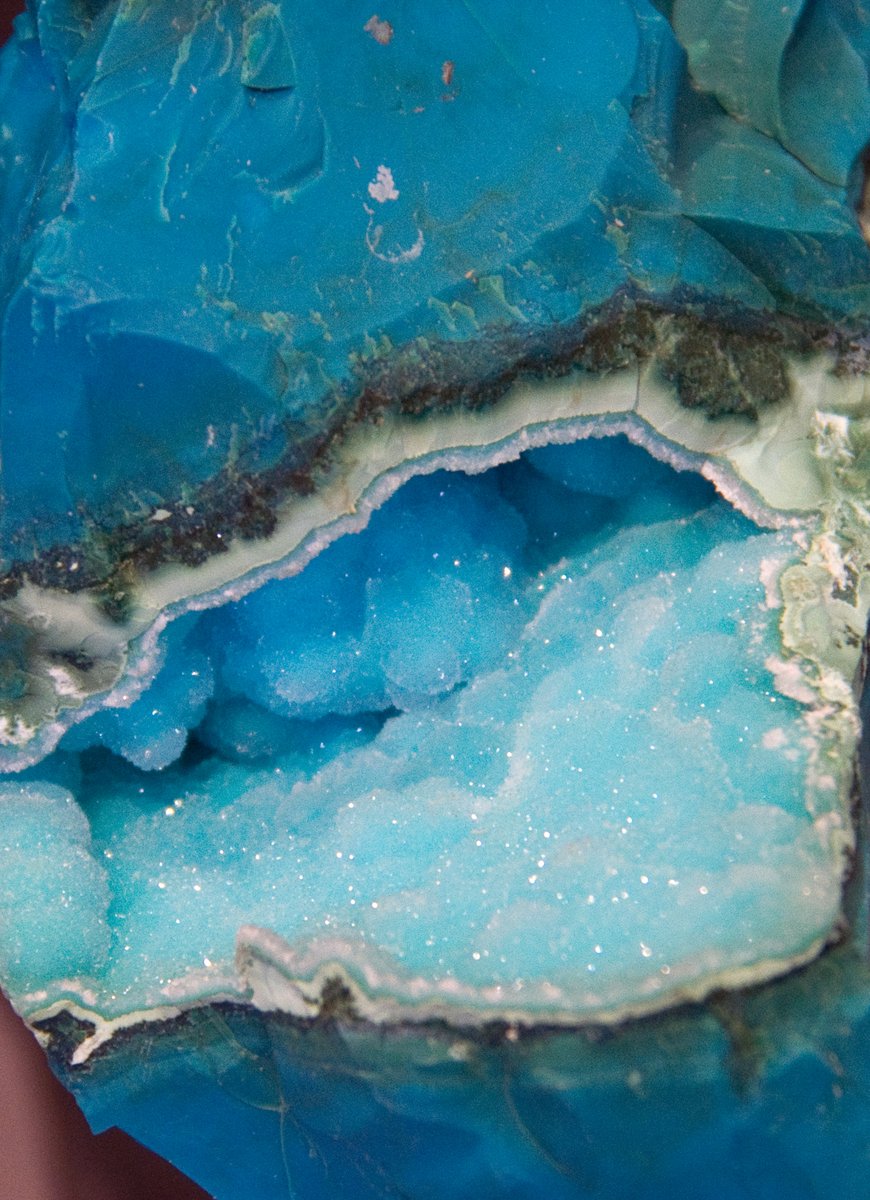
Chrysocolla
Crisocolla
Cu2-xAlx(H2-xSi2O5)(OH)4·nH2O Properties
- Color
- Blue, blue-green, green
- Luster
- Vitreous to waxy
- Density
- 2.0–2.4 g/cm³
- Category
- Mineral
Chrysocolla is a hydrated copper silicate mineral known for its vivid blue-green color, reminiscent of turquoise. It forms as a secondary mineral in the oxidation zones of copper deposits and is widely used as an ornamental stone and minor copper ore.
Chrysocolla is an amorphous to cryptocrystalline mineral, meaning it lacks a defined crystal structure. Its characteristic blue-green hues — ranging from sky blue to deep green — are due to its high copper content. The color can vary significantly depending on the presence of impurities: silica-rich specimens tend toward blue, while iron impurities produce greener tones.
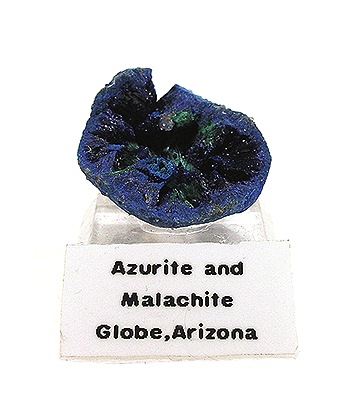
It frequently forms alongside malachite, azurite, turquoise, and native copper in the oxidized zones of porphyry copper deposits. The variety known as Eilat stone from Israel consists of intergrown chrysocolla, malachite, and turquoise and is prized in jewelry.
Chrysocolla is classified as a phyllosilicate with the approximate formula Cu2-xAlx(H2-xSi2O5)(OH)4·nH2O, though its exact composition varies widely. Its amorphous to cryptocrystalline nature results in a conchoidal fracture, waxy to vitreous luster, and hardness of 2–4 on the Mohs scale — too soft for most jewelry applications without stabilization. Refractive index: approximately 1.46–1.57. It is often found intimately mixed with quartz (silicified chrysocolla), which increases its durability significantly.
Mining localities
- Arizona, USA (Bisbee, Globe)
- Chile (Atacama)
- Democratic Republic of Congo
- Israel (Eilat)
- Peru
Frequently Asked Questions
How does chrysocolla form and where is it found?
Chrysocolla forms in the supergene oxidation zones of copper deposits, where aqueous solutions rich in copper and silica react with host rocks. It is primarily extracted from weathering zones in copper mines, with major deposits in Chile, Peru, Arizona, and Congo, often associated with malachite and azurite.
How do I recognize authentic chrysocolla and what is its hardness?
Authentic chrysocolla displays a characteristic blue-green color, vitreous to earthy luster, and very low hardness (2-2.5 on the Mohs scale), making it brittle and easily scratched. It is amorphous (non-visibly crystalline), forms coatings and compact masses, and leaves a blue-green streak when rubbed on a white tile.
Why is chrysocolla unsuitable for jewelry and how should it be stored?
Chrysocolla is too fragile and brittle to withstand jewelry wear due to its low hardness (2-2.5 Mohs) and amorphous nature. It should be stored in soft pouches separately, protected from moisture and thermal fluctuations, as it is sensitive to temperature changes and can dehydrate over time, altering its color.
What is the chemical composition of chrysocolla and what is its value?
Chrysocolla has the formula Cu₂H₂Si₂O₅(OH)₄ and is an amorphous hydrated copper silicate. Its commercial value is generally modest (€5-30 per kg for common specimens), although samples with intense color, compact mass, and provenance from celebrated deposits can command higher prices in specialized collector markets.
Entry generated with Claude API (Anthropic) on data extracted from Mindat, RRUFF and Wikipedia. Not yet reviewed by a human expert. Verify data against original sources before citing in formal work.