Dioptase
Dioptasio
CuSiO₂(OH)₂ Properties
- Category
- Mineral
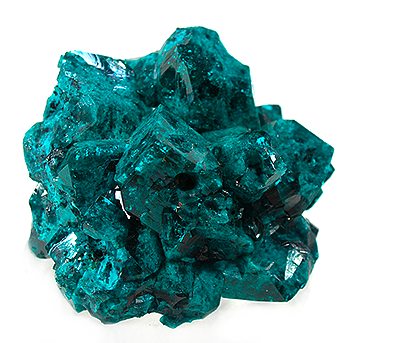
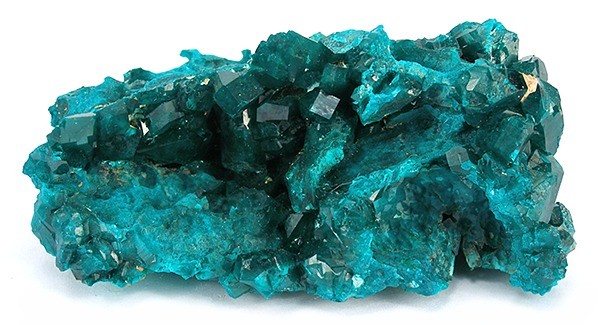
Dioptase is a rare copper mineral of intense emerald green, formed in oxidation zones of cupriferous deposits where silicon-rich waters alter primary sulfides. Its name derives from the Greek 'dioptazein' (to see through) for its characteristic transparency.
Dioptase is a hydrated copper silicate (CuSiO₂(OH)₂) that crystallizes in the trigonal system, forming characteristic prismatic crystals of extraordinarily vivid emerald green color. It forms exclusively in supergene environments, that is, in the surface alteration zones of copper deposits, where aqueous solutions rich in silicon dissolve primary copper minerals (chalcocite, chalcosite) and recrystallize them into more stable forms. Its moderate hardness (5 on the Mohs scale) makes it brittle for gemological use, but its transparency and saturated color make it extremely sought after by collectors. The most celebrated localities are Kazakhstan (Dzhezkazgan mine), Chile (Atacama), Namibia, and Peru, where crystals reach exceptional sizes. Its rarity and beauty position it among the most appreciated minerals by mineralogists, although it is practically absent from the commercial gemological market.
Dioptase crystallizes in the trigonal system (space group R3̄m), with lattice parameters a = 7.70 Å, c = 5.07 Å. Density is 3.28–3.35 g/cm³. The ordinary refractive index (nₒ) is approximately 1.644 and the extraordinary index (nₑ) is approximately 1.709, with positive birefringence of ~0.065. Hardness is 5 Mohs, with conchoidal fracture and imperfect cleavage along 1010. The intense color derives from Cu²⁺ in distorted octahedral coordination; the absorption spectrum shows characteristic bands in the green-blue region (around 650 nm and 450 nm). Chemical composition is stable only in neutral to alkaline pH environments and low oxidation potential; it frequently associates with limonite, malachite, azurite, and quartz. UV fluorescence is generally absent or very weak. Solubility in dilute acids is slow but appreciable, with release of Cu²⁺ ions and formation of silicic gel.
Mining localities
- Dzhezkazgan, Kazakistan (cristalli eccezionali fino a 5 cm)
- Atacama, Cile (depositi cupriferi del deserto settentrionale)
- Tsumeb, Namibia (miniera storica, cristalli di qualità museo)
- Mina Morococala, Perù (esemplari di grande dimensione)
- Altyn-Tyube, Kazakistan (seconda fonte mondiale più importante)
- Ajo, Arizona, USA (ritrovamenti storici, ora esauriti)
Frequently Asked Questions
Where is dioptase found and what are the main global deposits?
Dioptase forms exclusively in oxidation zones of copper deposits, where silicon-rich waters alter primary sulfides. The most important deposits are located in Kazakhstan (Altyn-Tyube), Namibia, Chile, Russia, and Arizona, with the finest and most transparent crystals coming from Kazakhstan.
How can you identify authentic dioptase from other similar green minerals?
Dioptase is unmistakable for its intense vivid emerald green color combined with its characteristic transparency, which gave it its name (from Greek 'dioptazein', to see through). Unlike malachite, it is transparent and crystallizes in trigonal form with rhombohedral habit, while other green stones like aventurine are opaque.
What is the chemical formula of dioptase and what are its main physical properties?
Dioptase has the chemical formula CuSiO₂(OH)₂ and contains copper as the chromophore element responsible for its green color. It exhibits hardness 5 on the Mohs scale, density of 3.3 g/cm³, transparency ranging from transparent to translucent, and relatively high fragility due to its crystal structure.
How much does dioptase cost and what factors influence its market price?
Dioptase is a rare mineral whose price varies significantly based on transparency, crystal size, and origin, ranging from tens to hundreds of euros per gram for exceptional specimens. Well-formed transparent crystals from Kazakhstan command the highest prices, while small-sized specimens or opaque aggregates are considerably less expensive.
Entry generated with Claude API (Anthropic) on data extracted from Mindat, RRUFF and Wikipedia. Not yet reviewed by a human expert. Verify data against original sources before citing in formal work.