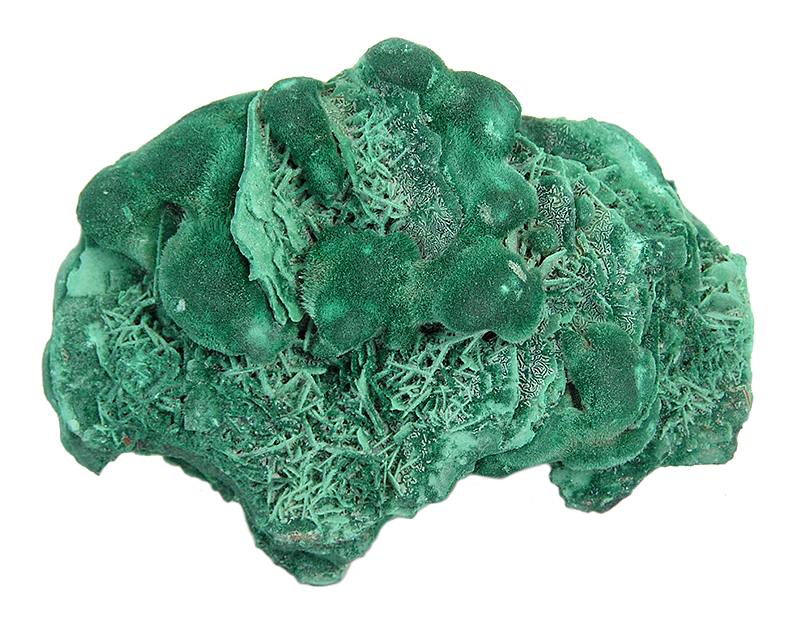
Malachite
Malachite
Cu₂(CO₃)(OH)₂ Properties
- Color
- Emerald green, light green
- Luster
- Vitreous, silky
- Density
- 3.6–4.0 g/cm³
- Category
- Mineral
Malachite is an intensely green copper carbonate, recognizable by its characteristic concentric bands resembling wood grain patterns. It is one of the oldest green minerals used by humans, serving as a pigment and ornament since ancient Egypt.
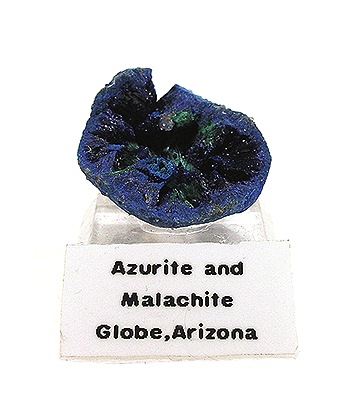
Malachite forms through secondary alteration of copper deposits, often in association with azurite, calcite, and limonite. Its botryoidal forms—aggregated spheres resembling grape clusters—are among the most distinctive in mineralogy. It was used as a green pigment in Egyptian and Renaissance paintings.
In Russia, large blocks of Ural malachite veneer the columns of St. Isaac's Cathedral in Saint Petersburg. The green stripes at the base of the FIFA World Cup Trophy are malachite.
Basic copper carbonate, monoclinic system, space group P21/a. The structure contains chains of CuO₆ octahedra linked by CO₃²⁻ and OH⁻ groups. Low hardness (3.5–4 Mohs) makes it unsuitable for daily-wear jewelry. Dust is toxic upon inhalation. Characteristic infrared spectrum with bands at 1490, 1420, 880, and 820 cm⁻¹.
Mining localities
- Katanga, Repubblica Democratica del Congo
- Monti Urali, Russia
- Bisbee, Arizona, USA
- Tsumeb, Namibia
- Sinai, Egitto (antichità)
Frequently Asked Questions
How can you tell real malachite from other green stones?
Authentic malachite is identified by its characteristic concentric bands of light and dark green arranged in regular patterns resembling wood grain. It is soft (hardness 3.5-4 Mohs), effervesces in dilute hydrochloric acid due to its carbonate composition Cu₂(CO₃)(OH)₂, and has a density of approximately 3.75-3.95 g/cm³, significantly higher than glass or other imitations.
Where is malachite found and what are the main mining deposits worldwide?
Malachite forms in oxidation zones of copper deposits, primarily in sedimentary and metamorphic environments. The largest worldwide deposits are in Zambia (which supplies 70% of global production), Democratic Republic of Congo, Russia (Urals), Australia, and Chile, where geological conditions favor the oxidative alteration of copper minerals.
What is the chemical formula of malachite and how does it form?
Malachite has the chemical formula Cu₂(CO₃)(OH)₂ and forms through the oxidation of primary copper minerals such as chalcopyrite in the presence of rainwater rich in CO₂. The process occurs in the supergene alteration zone, typically within the first 100 meters below the surface, where copper is dissolved and recrystallizes as a hydrated carbonate in gangue minerals and rock fractures.
How much does malachite cost and how does the price vary based on characteristics?
Malachite prices vary considerably: rough specimens of common quality are found at 5-20 euros per kg, while cut stones of gemstone quality with well-defined bands can reach 50-200 euros per carat. Determining factors are color intensity, regularity and visibility of concentric bands, size, and absence of cracks, with specimens from Zambia typically more valued for their superior crystal structure.
Entry generated with Claude API (Anthropic) on data extracted from Mindat, RRUFF and Wikipedia. Not yet reviewed by a human expert. Verify data against original sources before citing in formal work.