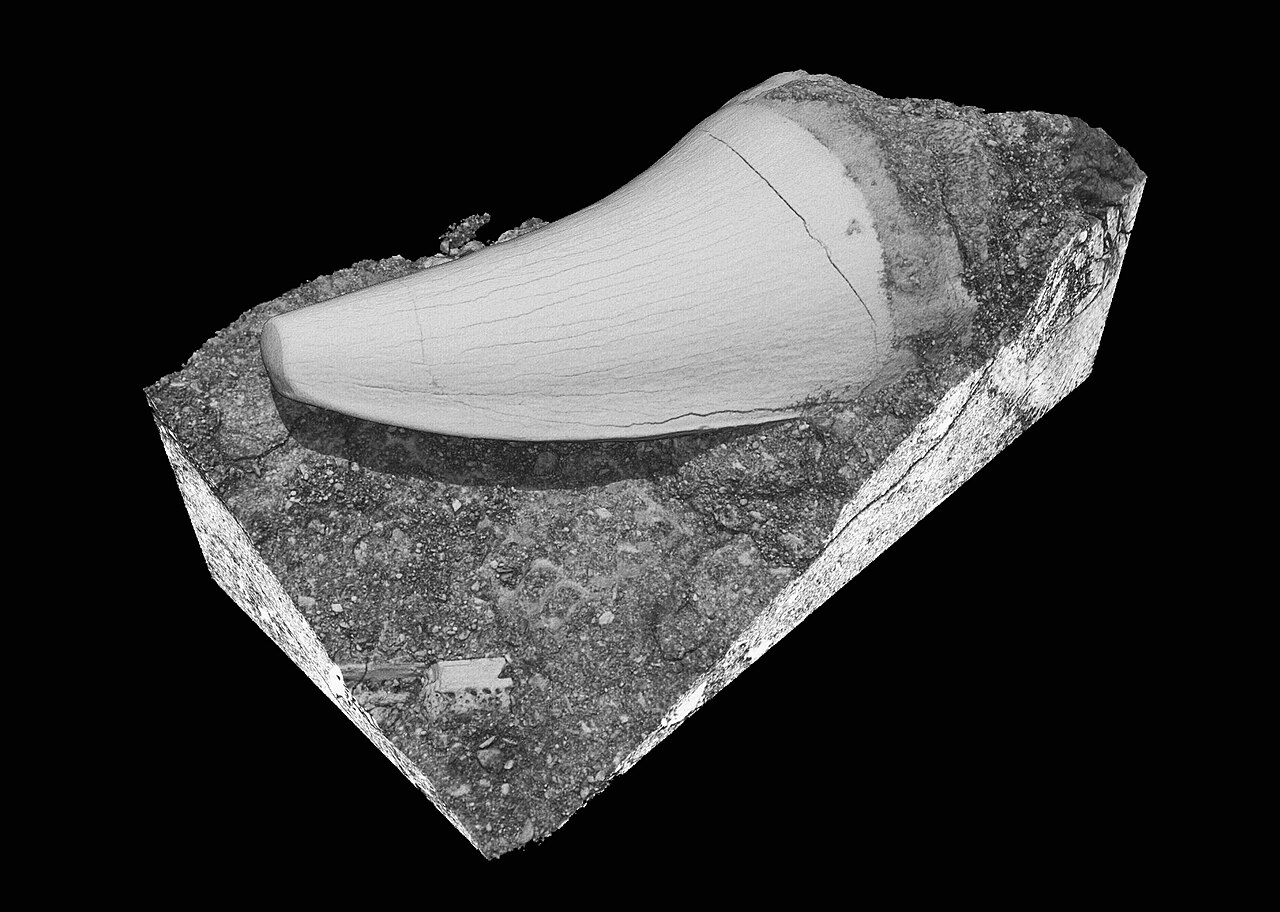
Mosasaur Tooth
Dente di Mosasauro
Ca₅(PO₄)₃F Properties
- Category
- Fossil
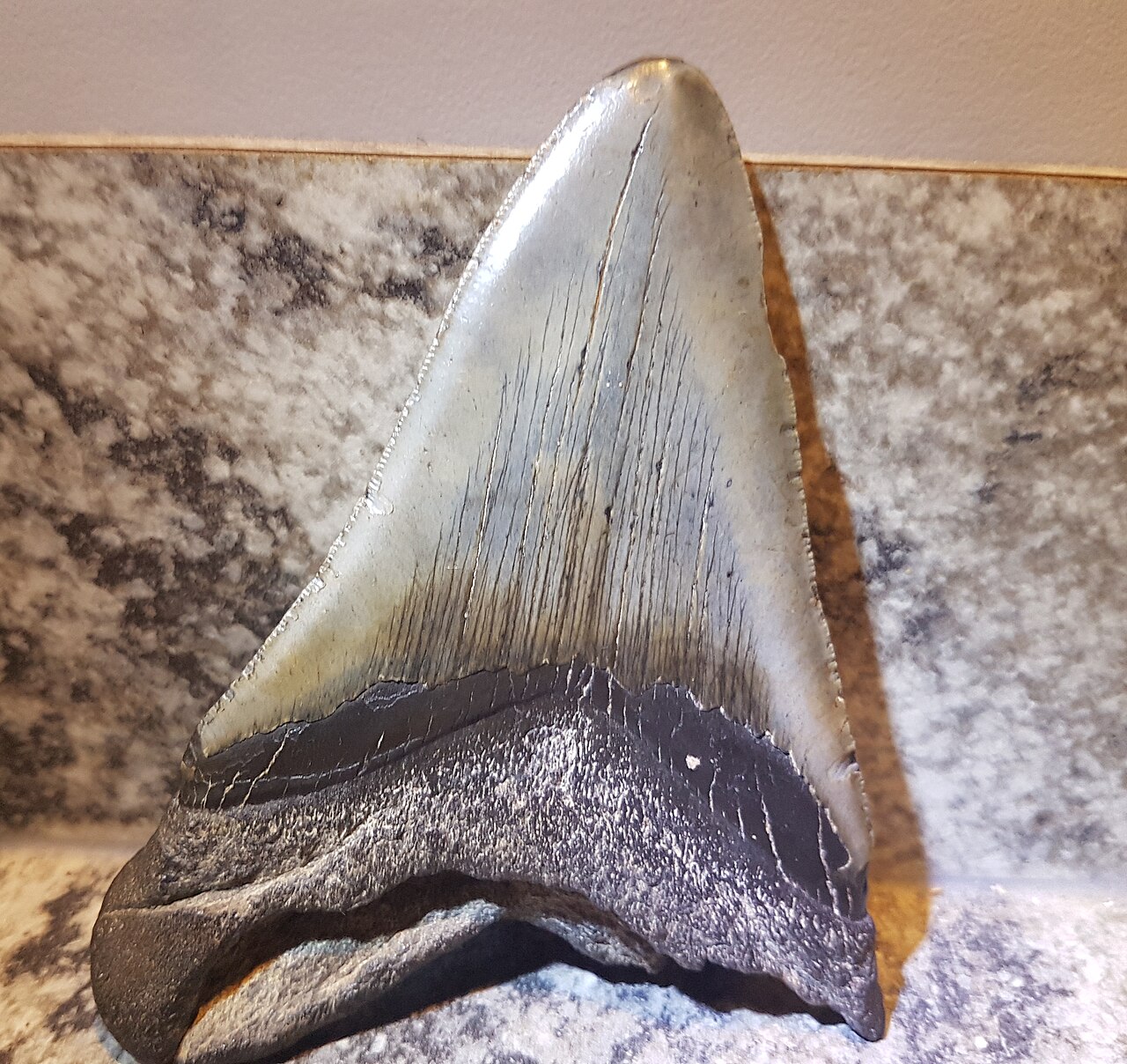
A mosasaur tooth is the preserved fossil of an extinct marine reptile (Mosasaurus), composed primarily of apatite (Ca₅(PO₄)₃F), the same mineral that forms the enamel of our teeth. These teeth, reaching lengths of up to 20 cm, testify to the ferocity of one of the largest marine predators of the Cretaceous, which went extinct 66 million years ago.
Mosasaur teeth are among the most fascinating fossils of the Late Cretaceous (100–66 million years ago). The mosasaur was a marine reptile belonging to the family Mosasauridae, an apex predator that could reach 17 meters in length. Its curved and sharp teeth were covered by a layer of enamel rich in fluorapatite and anchored in bony sockets by means of a hollow root. Their conical shape and slightly flattened cross-section reflect an evolutionary adaptation for cutting flesh and piercing the scales of Mesozoic fish.
The mineralogical composition is dominated by apatite in the francolite variety, with traces of residual organic matter and occasional sediment inclusions. During fossilization, primary minerals remain substantially unaltered, although porosity increases over time. The best-preserved teeth come from marine phosphate-rich deposits, such as those in Morocco, Jordan, and North American Cretaceous sediments. Collectors and museums particularly seek teeth with intact roots and lustrous enamel, which indicate rapid exhumation and favorable diagenesis.
Composition: Ca₅(PO₄)₃F with variations in ionic substitution (francolite with Sr, Ba, Na). Crystal system: hexagonal, space group P63/m, lattice parameters a ≈ 9.37 Å, c ≈ 6.88 Å. Mohs hardness: 5 (enamel), 4–4.5 (underlying dentin). Density: 3.15–3.25 g/cm³. Refractive index: nω ≈ 1.633, nε ≈ 1.627 (weak negative birefringence). Raman spectroscopy: characteristic PO₄³⁻ peaks at 960, 1050 cm⁻¹; F⁻ shows no distinct peak. XRD analysis: well-defined (002), (211), (300) reflections, with broadening due to structural disorder and inclusions. UV fluorescence: weak to moderate, color ranging from blue to orange depending on rare element concentration (Eu²⁺, Mn²⁺). Microstructure: needle-shaped apatite crystals oriented perpendicular to the external surface, with gradual transition to more porous dentin. Diagenetic alteration: partial substitution of Ca with Sr, incorporation of CO₃²⁻ (carbonate apatite), loss of F⁻ in oxidizing environments.
Mining localities
- Marocco, Fosfatiere del Gantour
- Giordania, Bacino del Giordano
- Stati Uniti, Formazione Niobrara (Kansas, Colorado)
- Belgio, Bacino di Mons
- Paesi Bassi, Maastricht
- Argentina, Formazione La Colonia (Patagonia)
Frequently Asked Questions
What mineral is a mosasaur tooth made of?
A mosasaur tooth is composed primarily of apatite, chemical formula Ca₅(PO₄)₃F, the same mineral that makes up human tooth enamel and bone. This calcium fluoride phosphate is extremely resistant and allows for excellent preservation of fossils even after millions of years. The hardness and density of apatite ensure that these teeth maintain their original structure even after fossilization.
How to identify a real mosasaur tooth from a fake?
An authentic mosasaur tooth exhibits a dark and porous root, a sharp tip sometimes slightly worn, and a surface that may show natural fossil patina marks. Modern fakes often have surfaces that are too smooth, unnaturally uniform colors, and lack the microscopic wear characteristics typical of a 70-million-year-old fossil. X-ray diffraction analysis can definitively confirm the original apatite composition.
How much does a mosasaur tooth cost and where to buy it?
Mosasaur tooth prices vary considerably: small specimens (3-5 cm) cost between 20 and 100 euros, while larger and well-preserved teeth can reach 500-2000 euros or more. You can purchase them from specialized mineral dealers, fossil exposition fairs, online collecting platforms, and museums with sales sections. It's important to buy from certified sellers who guarantee authenticity and provide documentation on the geological provenance of the fossil.
How is a fossilized mosasaur tooth formed?
When a mosasaur died, its apatite teeth were quickly covered by marine sediments that protected them from degradation. Over millions of years, through diagenesis processes, surrounding minerals infiltrated the space around the tooth, gradually replacing the original organic matrix and completely mineralizing the structure. Apatite, being already chemically stable and resistant, preserves itself completely, maintaining the original form and morphological characteristics of the predator's tooth.
Entry generated with Claude API (Anthropic) on data extracted from Mindat, RRUFF and Wikipedia. Not yet reviewed by a human expert. Verify data against original sources before citing in formal work.