Native Copper
Rame Nativo
Cu Properties
- Category
- Mineral
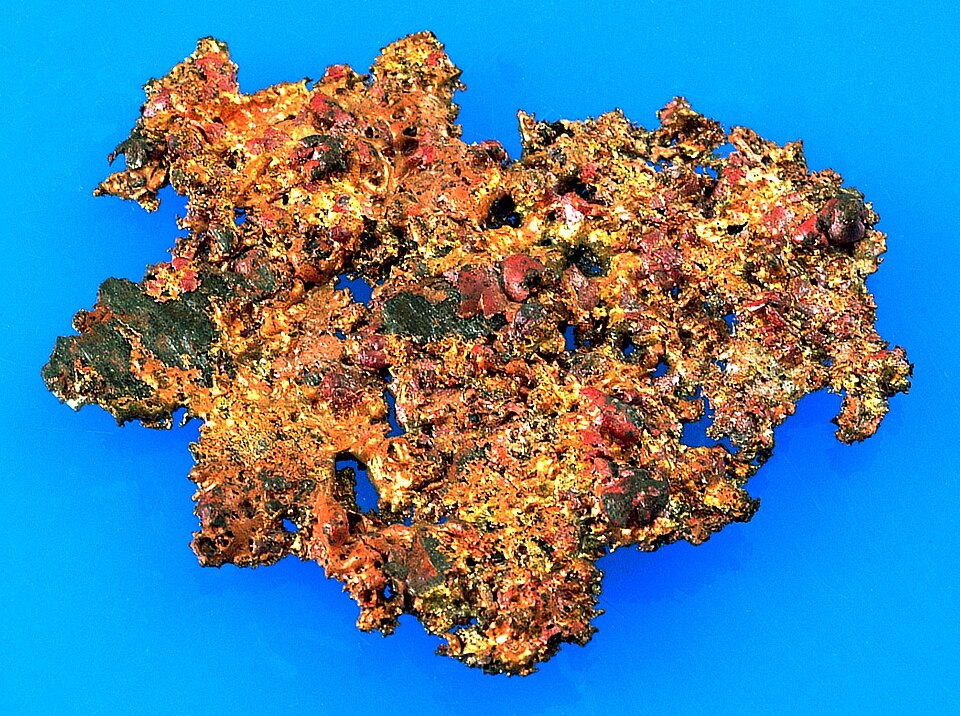
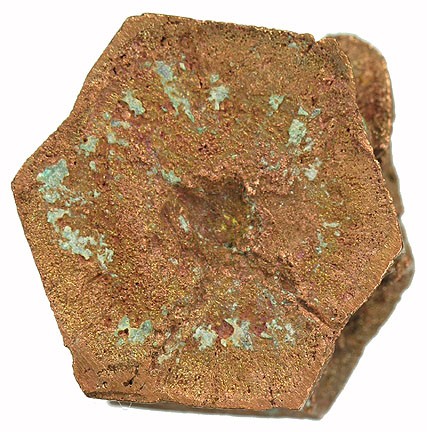
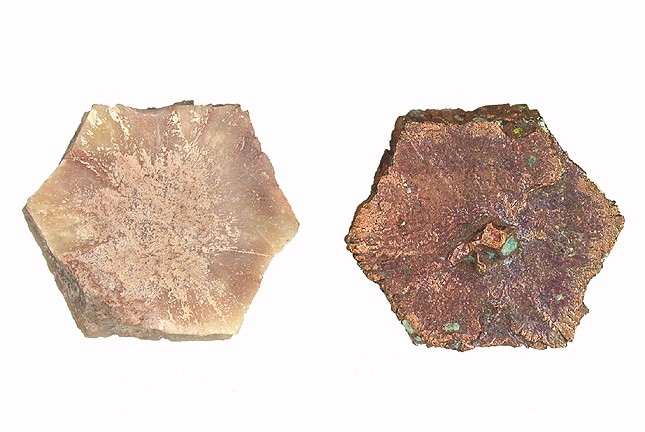
Native copper is pure copper (Cu) found in nature already in metallic form, without requiring extraction from ore minerals: it is one of the few metals that Earth spontaneously produces in crystals and compact masses, with a characteristic red-orange color.
Native copper represents one of the most geologically fascinating metallic minerals, as its formation requires rather rare reducing conditions. It originates predominantly in two environments: in the *oxidation zone* of copper sulfide deposits, where Cu²⁺-rich waters are reduced by organic material or underlying sulfides, or in low-temperature hydrothermal environments associated with zeolites and calcite. Native copper crystallizes in the cubic system, but rarely forms well-defined crystals: it more commonly appears as dendritic masses, filiform, or lamellar forms. Its extreme ductility and malleability (hardness 2.5–3 Mohs) make it easily recognizable under the microscope and to the touch. Historically, native copper held extraordinary archaeological importance: ancient civilizations worked it directly without smelting, as evidenced by artifacts from the Neolithic and Copper Age. From a collecting perspective, the most prized specimens come from Butte (Montana), Keweenaw (Michigan), and Namibia, where spectacular masses and well-formed crystals are found.
Crystallographic data: Cubic system, space group Fm3̄m, lattice parameter a = 3.615 Å. Physical properties: Hardness 2.5–3 Mohs; density 8.96 g/cm³; cleavage absent; fracture irregular; metallic luster; red-orange color, sometimes with black patina of oxides (CuO, Cu₂O). Optical and magnetic properties: Opaque; excellent electrical conductivity (σ ≈ 5.96 × 10⁷ S/m at 20 °C); diamagnetic. Spectroscopy: Characteristic IR absorption at 600–400 cm⁻¹ (lattice vibrations); XRD shows diagnostic reflections (111), (200), (220). Mineralogical associations: Frequent with cuprite (Cu₂O), malachite [Cu₂(OH)₂CO₃], azurite [Cu₃(OH)₄(CO₃)₂], calcite, zeolites (analcime, laumontite). Genesis: Precipitation from hydrothermal solutions in reducing environment (Eh < +0.3 V at pH 6–8); replacement of sulfides in oxidation zone; occasionally in altered basalts through reduction of Cu²⁺ ions by H₂S. Diagnostic markers: Extreme malleability; immutable red-orange color; high density; absence of cleavage; positive reaction with dilute HNO₃ (dissolution with formation of blue-green NO₂).
Mining localities
- Keweenaw Peninsula, Michigan, USA — cristalli e masse dendritiche eccezionali
- Butte, Montana, USA — giacimenti storici con rame nativo in associazione con solfuri
- Namibia (Tsumeb, Otavi) — campioni spettacolari con cristalli ben formati
- Atacama, Cile — zone di ossidazione di grandi depositi porfirici
- Ural, Russia — rame nativo in contesti idrotermali
- Cornuaglia, Inghilterra — depositi storici di estrazione mineraria
Frequently Asked Questions
How is native copper formed in nature?
Native copper forms primarily through chemical reduction processes, when aqueous solutions rich in copper (Cu²⁺) contact reducing materials such as organic matter or mineral sulfides in the oxidation zones of copper deposits. This natural process produces crystals and masses of pure copper (Cu) without human intervention, making it one of the rarest native metals found on Earth.
Where is native copper found in the world?
Native copper concentrates mainly in oxidation zones of copper deposits, with the most important occurrences in the USA (Michigan, Arizona), Zambia, Chile, Congo, and Russia. Zones with slightly acidic groundwater and sulfide-bearing sediments more favorably promote the formation of economically significant native copper.
How do I recognize native copper from other minerals?
Native copper is unmistakable thanks to its characteristic red-orange color and relatively low hardness (2.5-3 on the Mohs scale), making it malleable and flexible. A simple test is to verify that the mineral leaves a copper-colored impression on white paper (characteristic red streak) and that it is very heavy for its size due to high density (8.9 g/cm³).
What is the value and price of native copper?
The price of native copper for collectors ranges from €5-15 per gram for commercial-quality specimens, while well-crystallized or historically significant examples reach €20-50 per gram. Value depends on purity (must contain at least 99% Cu), crystal size, aesthetic quality, and documented geological origin.
Entry generated with Claude API (Anthropic) on data extracted from Mindat, RRUFF and Wikipedia. Not yet reviewed by a human expert. Verify data against original sources before citing in formal work.