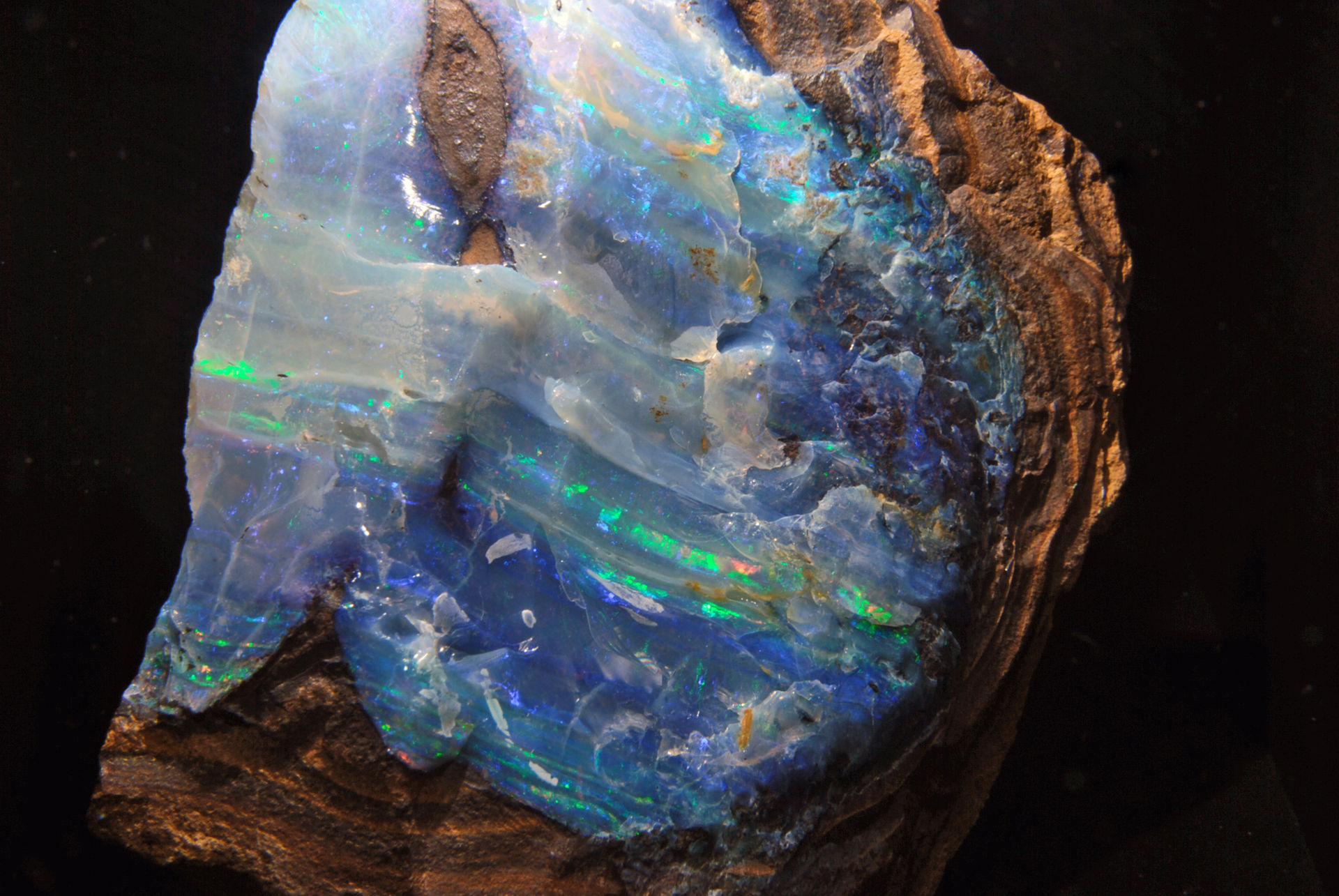
Opal
Opale
SiO₂·nH₂O Properties
- Color
- White, black, orange, multicolored
- Luster
- Vitreous, resinous
- Density
- 1.98–2.25 g/cm³
- Category
- Gem
Opal is the only amorphous gem — it lacks crystalline structure — and is celebrated for its extraordinary play-of-color, an optical phenomenon that produces flashes of iridescent light with movement. Each opal is unique in the world for its chromatic pattern.
The play-of-color is caused by light diffraction on silica spheres arranged in regular layers at nanometric dimensions. Black opal from Lightning Ridge, with a dark background that amplifies colors, is the most prized in the world.
Opal contains 3 to 21% water trapped within its structure — for this reason it can crack if it dries too rapidly. Storage in a humid environment is recommended for fine specimens.
Hydrated amorphous silica (mineraloid), not technically a mineral due to the absence of crystalline structure. The internal structure is composed of SiO₂ spheres of 150–300 nm stacked in pseudo-cubic face-centered arrays. SEM analysis reveals the spherical structure. Refractive index 1.37–1.47.
Mining localities
- Lightning Ridge, New South Wales, Australia (opale nero)
- Coober Pedy, South Australia (opale bianco)
- Querétaro, Messico (opale di fuoco)
- Etiopia (opale Welo)
- Slovacchia (opale nobile storico)
Frequently Asked Questions
Why does opal have such a fascinating play of color?
The play of color (opalescence) occurs because opal's amorphous structure contains microspheres of silica arranged in regular patterns that diffract light into iridescent spectra. This optical phenomenon is unique compared to crystalline stones and makes every opal extraordinarily individual in its chromatic pattern.
How does opal form and where is it found?
Opal (formula: SiO₂·nH₂O) forms when silica solutions deposit in rock cavities and slowly solidify over millions of years, creating thin layers. The main deposits are found in Australia (which produces 95% of the world's opal), as well as in Mexico, Brazil, and other regions with past geothermal activity.
Is opal fragile? How should I care for an opal?
Opal is relatively fragile compared to other gemstones: without crystalline structure, it has a hardness of 5.5-6.5 on the Mohs scale and is sensitive to impacts and humidity changes. To keep it intact, store it away from heat sources, avoid sudden temperature and humidity fluctuations, avoid exposure to harsh chemicals, and wear it carefully during physical activities.
What are the main types of opal and which are the most valuable?
There are two categories: precious opal (with evident play of color) and common opal (without opalescence). The most sought-after precious opals are Australian Black Opal, Mexican Fire Opal, and White Opal, with prices varying enormously from tens to thousands of euros per carat depending on the play of color and absence of cracks.
Entry generated with Claude API (Anthropic) on data extracted from Mindat, RRUFF and Wikipedia. Not yet reviewed by a human expert. Verify data against original sources before citing in formal work.