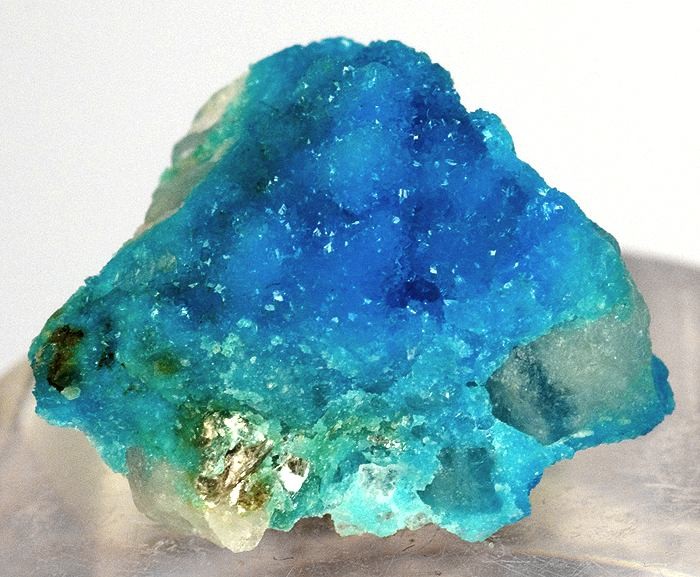
Turquoise
Turchese
CuAl₆(PO₄)₄(OH)₈·4H₂O Properties
- Color
- Sky blue, blue-green
- Luster
- Waxy, opaque
- Density
- 2.6–2.9 g/cm³
- Category
- Gem
Turquoise is a copper and aluminum phosphate distinguished by its characteristic sky-blue color, one of the oldest ornamental stones in the world. Its name derives from the French "pierre turquoise"—Turkish stone—because it reached Europe through Turkey.
The blue color is caused by copper, while green hues indicate the presence of iron. Iranian turquoise from Nishapur is considered the finest in the world for its pure blue color without veining. Most commercial turquoise is treated with resins to stabilize its color.
It was a sacred stone of the Aztecs and ancient Egyptians, used in funerary masks and amulets. Turquoise from Cerrillos, New Mexico, has been mined by Native Americans for over 2,000 years.
Hydrated copper and aluminum phosphate, triclinic system, space group P1̄. It forms through supergene alteration in arid zones with aluminum- and copper-rich rocks. The refractive index is 1.61–1.65. Variable porosity explains the necessity for stabilizing treatments. FTIR and Raman spectroscopy distinguish natural turquoise from imitations.
Mining localities
- Nishapur, Iran (qualità più elevata)
- Sinai, Egitto
- Arizona e New Mexico, USA
- Cina
- Turkmenistan
Frequently Asked Questions
How is turquoise formed and where is it found?
Turquoise forms through supergene alteration of copper and aluminum-rich rocks when phosphate-rich waters percolate through mineralized zones. Major deposits are located in Iran, Afghanistan, Peru, Arizona, and China, with Iranian turquoise being considered the finest quality.
How can you distinguish genuine turquoise from fakes and imitations?
Authentic turquoise has a hardness between 5 and 6 on the Mohs scale and displays characteristic porosity that makes it lighter than glass or plastic imitations. A reliable test is the heat test: genuine turquoise changes color when exposed to high temperatures, while imitations do not.
What is the price of turquoise and what determines its value?
Turquoise prices range from a few euros per gram for common specimens to hundreds of euros for high-quality Persian turquoise. Value depends primarily on origin, intense blue color (rarer and more sought-after), reduced porosity, and absence of matrix inclusions.
Is turquoise a porous and sensitive stone? How should it be maintained?
Turquoise is porous and hydrated (containing water in its formula CuAl₆(PO₄)₄(OH)₈·4H₂O), making it sensitive to solvents, oils, sweat, and detergents that can alter its color and luster. It should be gently cleaned with warm water and neutral soap, avoiding prolonged contact with moisture and chemicals.
Entry generated with Claude API (Anthropic) on data extracted from Mindat, RRUFF and Wikipedia. Not yet reviewed by a human expert. Verify data against original sources before citing in formal work.