Chalcedony
Calcedonio
SiO₂ Properties
- Category
- Gem
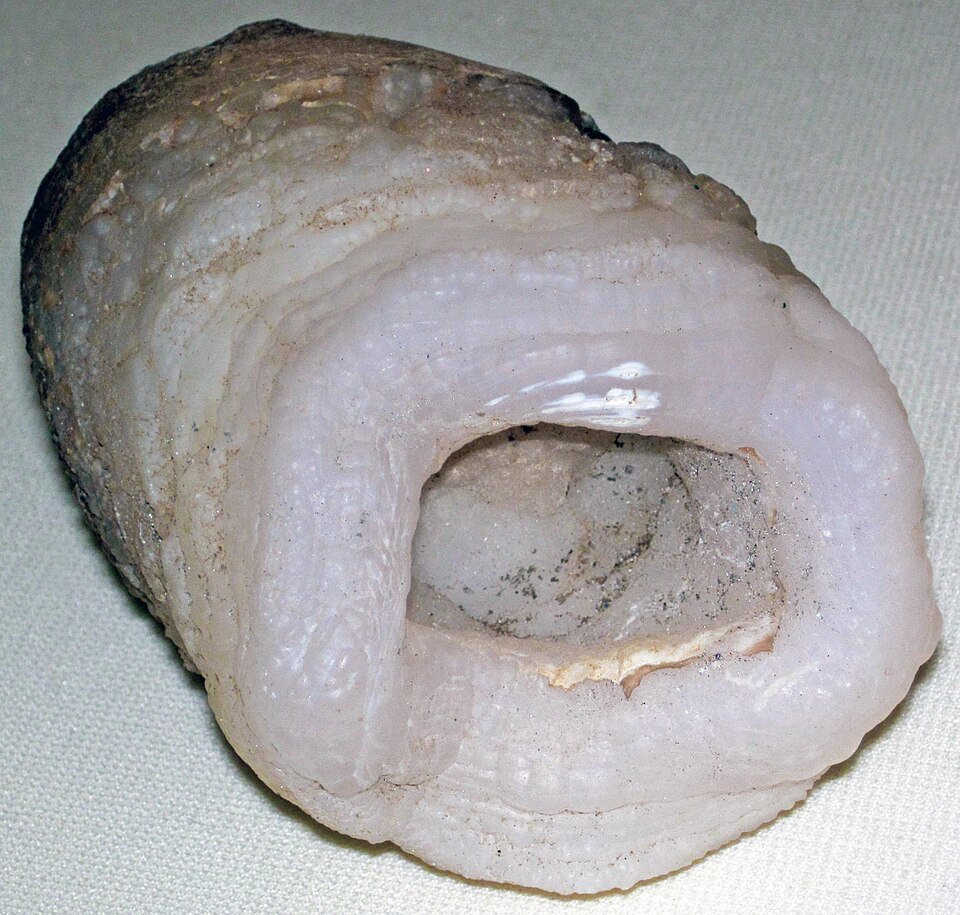
Chalcedony is a microcrystalline variety of quartz (SiO₂) that forms in volcanic and sedimentary environments, characterized by a compactness that makes it ideal for jewelry processing. Available in an extraordinary range of colors—from milky white to blue, red, green, and brown—chalcedony has fascinated collectors and artisans since antiquity.
Chalcedony is a *microcrystalline* variety of quartz, composed of quartz crystals so minute that they are visible only under a microscope. Unlike macroscopic crystalline quartz, its fine-grained structure imparts a characteristic waxy luster and translucency that make it ideal for sculpture and carving. It forms primarily in volcanic environments during the cooling of silica-rich rocks, and in sedimentary environments as infilling of cavities in calcareous or basaltic rocks.
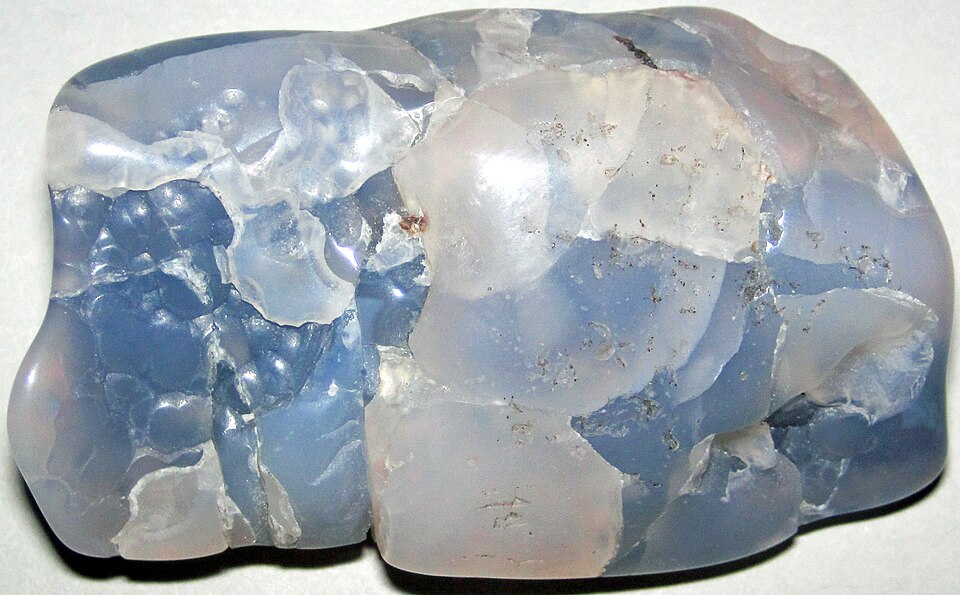
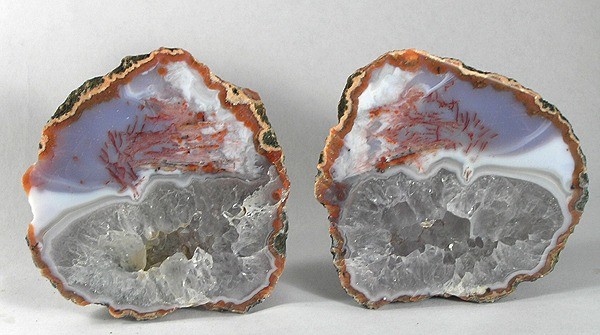
The colored varieties of chalcedony have specific names: *agate* (when it displays colored bands), *sardonyx* (reddish-brown), *chrysoprase* (apple green), *blue chalcedony* (from copper), and *heliotrope* (green with red spots). Historically, chalcedony was one of the most important materials for glyptics (the art of carving hard stones): ancient Egyptians, Greeks, and Romans used it for seals, amulets, and cameos. In the contemporary gemological market, the finest quality chalcedonies come from Botswana, Brazil, India, and Madagascar, where specimens with intense coloration and superior transparency are found.
Chemical composition: SiO₂ (silicon dioxide); impurities of Fe, Cu, Ni, Cr responsible for coloration.
Crystal system: Trigonal (α-quartz structure); crystal habit: typically massive and botryoidal (*botryoidal*), rarely with visible crystals.
Hardness: 6.5–7 Mohs; fracture: conchoidal (*conchoidal*); density: 2.58–2.64 g/cm³.
Refractive index: nω = 1.530–1.534; nε = 1.539–1.543 (positive uniaxial birefringent); birefringence: ~0.009.
UV-Vis spectroscopy: Blue chalcedony shows absorption in the visible range due to coordinated Cu²⁺ ions; characteristic absorption spectrum between 600–700 nm. Fluorescence: generally absent or weak under long and short wave UV.
Inclusions and treatments: Frequent inclusions of iron oxides (hematite, limonite) that produce red and yellow coloration. Natural blue chalcedony is rare; many commercial specimens are tinted with copper salts. Thermal treatments are common to intensify coloration. Thermal stability is good up to ~573 °C (α→β quartz transition).
Mineralogical associations: Commonly associated with crystalline quartz, opal, zeolites, and iron oxides in volcanic geodes and sedimentary nodules.
Premier sources: Botswana (banded Botswana agate), Brazil (blue chalcedony from Rio Grande do Sul), Madagascar (chrysoprase), India (Dhulia agate).
Mining localities
- Botswana — Agate di Botswana (striature bianche e nere)
- Brasile — Rio Grande do Sul (calcedonio blu, crisoprasio)
- Madagascar — Crisoprasio di qualità gemmologica
- India — Dhulia, Gujarat (agata multicolore)
- Namibia — Agate del deserto del Kalahari
- Stati Uniti — Oregon, Idaho (agata stratificata)
- Messico — Calcedonio rosso e marrone
- Turchia — Agate di Anatolia
Frequently Asked Questions
What is the difference between chalcedony and crystalline quartz?
Chalcedony is a microcrystalline variety of quartz (SiO₂) with crystals so small they are invisible to the naked eye, whereas crystalline quartz displays well-formed, visible crystals. This microcrystalline structure gives chalcedony superior compactness and better workability for jewelry carving and cameos.
How is chalcedony formed and where is it found in nature?
Chalcedony forms in volcanic and sedimentary environments when silicon-rich solutions gradually deposit in rock cavities, creating microscopic layers of SiO₂. Major deposits are found in Brazil, India, Madagascar, and Mediterranean volcanic zones, where geological conditions favor this precipitation process.
How to identify authentic chalcedony and what is its average price?
Authentic chalcedony has a hardness of 6.5 to 7 on the Mohs scale, appears translucent or opaque with a waxy luster, and lacks the prominent crystal striations seen in crystalline quartz. Prices range from 5 to 50 euros per carat depending on the colored variety, with rare specimens commanding higher prices.
What are the main colored varieties of chalcedony and what are they called?
The most notable varieties include carnelian (red-orange), agate (multicolored in bands), blue chalcedony (from azure to turquoise), and green chalcedony (often confused with chrysoprase). All share the microcrystalline SiO₂ structure but differ in mineral impurities (iron, nickel, copper oxides) that generate the extraordinary color range.
Entry generated with Claude API (Anthropic) on data extracted from Mindat, RRUFF and Wikipedia. Not yet reviewed by a human expert. Verify data against original sources before citing in formal work.