Chalcopyrite
Calcopirite
CuFeS₂ Properties
- Category
- Mineral
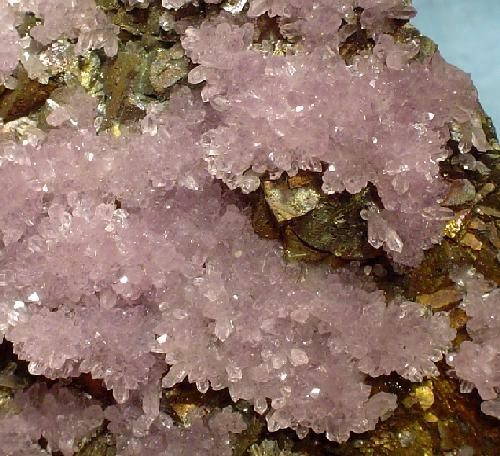
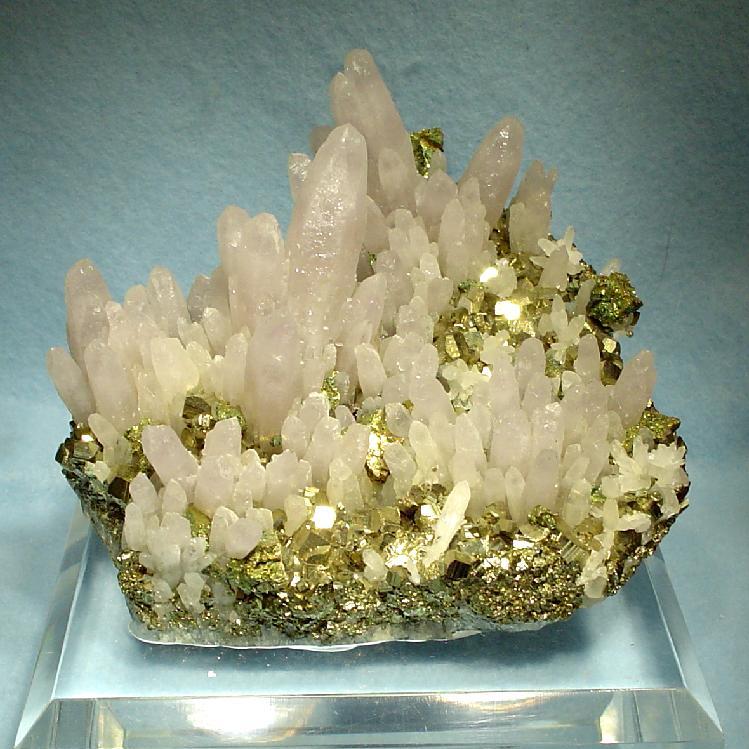
Chalcopyrite is the most economically important copper mineral, characterized by a metallic yellow-bronze color and the chemical formula CuFeS₂. It forms primarily in hydrothermal environments and represents the primary source of copper for the global industry.
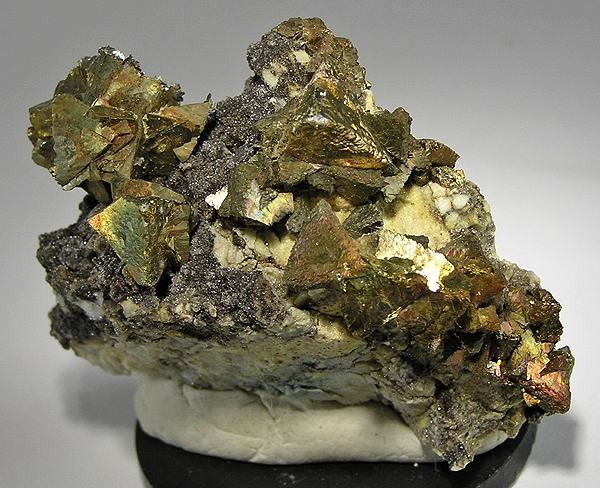
Chalcopyrite (CuFeS₂) is a mixed sulfide of copper and iron that crystallizes in the tetragonal system, although it often exhibits pseudocubic forms that make it easily confused with pyrite. Its hardness of 3.5–4 on the Mohs scale and characteristic brittleness distinguish it from harder minerals. It forms in highly diverse geological contexts: in high-temperature hydrothermal environments as a primary mineral associated with magnetite and bornite, in granitic pegmatites, and especially in porphyry copper deposits where it represents the principal mineral of economic interest. Chalcopyrite is also notable for the phenomenon of iridescence—a changeable blue-violet coloration that appears on the oxidized surface—due to the formation of thin layers of secondary oxides. Historically, it was confused with gold by inexperienced prospectors, earning it the nickname "fool's gold." Its economic importance is enormous: from a single kilogram of chalcopyrite, approximately 340 grams of pure copper can be extracted.
Chalcopyrite crystallizes in the tetragonal system, space group I4̄2d, with lattice parameters a = 5.29 Å and c = 10.44 Å. The structure is derived from sphalerite with doubling of the unit cell along the c-axis due to alternating ordering of Cu and Fe in tetrahedral sites. Density: 4.1–4.3 g/cm³. Refractive index (reflected light): marked anisotropy with color variations from yellow-bronze to copper-yellow. Semiconducting electrical conductivity (p-type). Raman spectroscopy shows characteristic bands at ~290 cm⁻¹ (Cu-S stretching) and ~350 cm⁻¹ (Fe-S stretching). XRD analysis allows distinction from pyrite (cubic, a = 5.42 Å) and bornite (cubic, a = 10.94 Å). Chalcopyrite is paramagnetic at room temperature. Under surface oxidation it forms covellite (CuS) and chalcocite (Cu₂S). Typical mineral associations: magnetite, hematite, bornite, pyrite, sphalerite, galena, quartz. Soluble in dilute nitric acid with formation of yellow elemental sulfur.
Mining localities
- Chuquicamata, Cile (uno dei maggiori depositi porfirici di rame al mondo)
- Butte, Montana, USA (deposito storico di rame)
- Cornuaglia, Regno Unito (miniere storiche di stagno e rame)
- Bor, Serbia (importante deposito porferico)
- Kitakami, Giappone (associato a magnetite)
- Sudbury, Canada (negli scisti cupriferi)
- Tsumeb, Namibia (deposito polimetallico classico)
- Perù (Antapaccay, Toquepala, Cuajone)
Frequently Asked Questions
How to recognize chalcopyrite and distinguish it from pyrite?
Chalcopyrite distinguishes itself from pyrite primarily by its warmer yellow-bronze color and lower hardness (3.5-4 on Mohs scale versus 6-6.5 for pyrite). A decisive test is the streak color: chalcopyrite leaves a green-black mark while pyrite leaves a black-greenish streak, and chalcopyrite becomes magnetic after heating while pyrite does not.
Where is chalcopyrite found in the world and what are the major deposits?
Chalcopyrite (CuFeS₂) forms predominantly in hydrothermal environments and is present in the world's major copper deposits, including Chile (with Chuquicamata and El Teniente deposits), Peru, the United States, and Zambia. These deposits represent the primary source of global copper extraction because chalcopyrite contains 34.6% copper by weight and is economically the most convenient to process.
What is the value and price of chalcopyrite as a collector mineral?
The price of chalcopyrite as a collector mineral varies widely from 5-10 euros for small unpolished samples up to 100-500 euros for well-formed crystals of superior quality, depending on size, transparency, and origin. At the industrial level, the economic value is determined by the global market price of copper, which in 2024 fluctuates around 9,000-10,000 dollars per ton of pure copper.
How does chalcopyrite form and in which geological environments does it develop?
Chalcopyrite (CuFeS₂) forms primarily in hydrothermal environments associated with magmatism, where copper and iron-rich fluids precipitate in fracture zones of the Earth's crust at temperatures between 300-500°C. It also develops in porphyry alteration environments and in low-grade metamorphic settings, often in association with other sulfides such as pyrite, sphalerite, and galena in economically important polymetallic deposits.
Entry generated with Claude API (Anthropic) on data extracted from Mindat, RRUFF and Wikipedia. Not yet reviewed by a human expert. Verify data against original sources before citing in formal work.