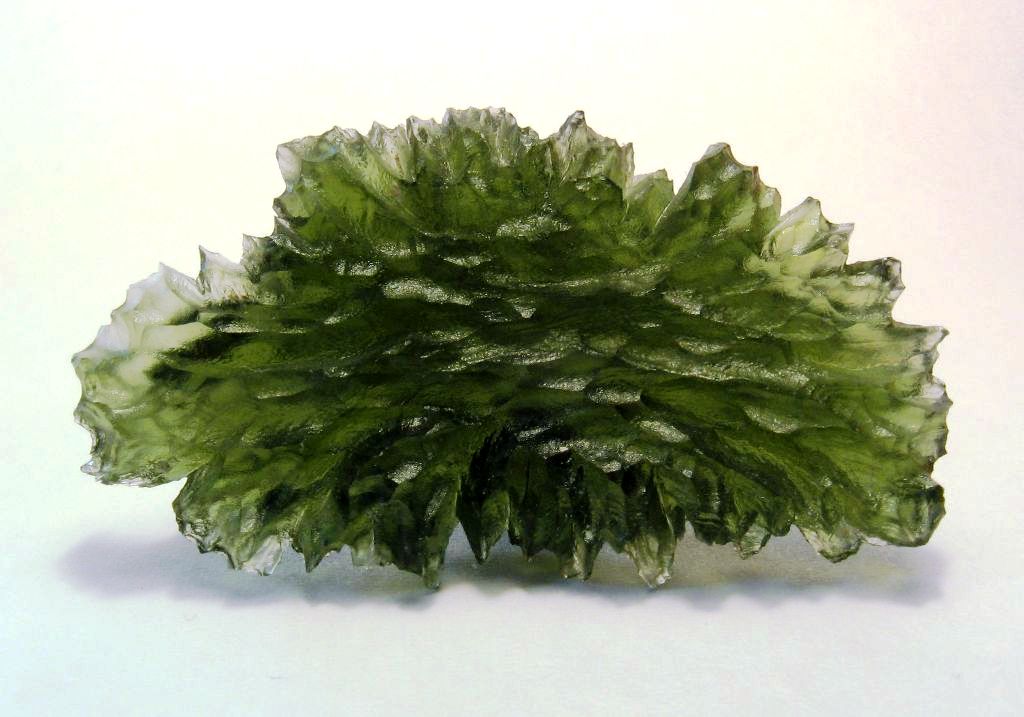
Moldavite
Moldavite
SiO₂ + Al₂O₃ Properties
- Category
- Meteorite
Moldavite is an amorphous natural glass formed approximately 15 million years ago by a meteorite impact in what is now the Czech Republic, characterized by a distinctive bottle-green color and a glassy structure devoid of ordered crystals.
Moldavite represents one of the rare examples of tektite, an impact glass formed from the kinetic energy of a meteorite that struck the Moldavia region (from which it derives its name) during the Miocene. The event, known as the Ries impact, generated temperatures exceeding 1700 °C that instantaneously melted local silicate rocks, creating a homogeneous glass of predominantly silicate composition with traces of aluminum. The characteristic green color derives from bivalent iron (Fe²⁺) traces trapped in the amorphous structure during rapid cooling.
From a gemological perspective, moldavite is appreciated by collectors for its geological rarity and unique appearance, although its relatively low hardness (5.5 on the Mohs scale) makes it unsuitable for everyday jewelry. The finest specimens come from the Czech Republic, particularly from the southern Moldavia region, where fragments can still be found at archaeological sites and in alluvial deposits. Since approximately 1990, the gemological market has witnessed a significant increase in demand, leading to price increases and greater awareness of moldavite among international collectors. Transparent specimens with minimal inclusions command notable prices, while opaque ones remain more accessible.
Moldavite is an amorphous silicate glass with approximate composition SiO₂ 75–80%, Al₂O₃ 10–15%, Fe₂O₃ + FeO 2–4%, with traces of CaO, MgO, K₂O, and Na₂O. The absence of ordered crystalline structure is confirmed by X-ray diffraction, which produces a characteristic amorphous pattern. Density ranges from 2.32 to 2.38 g/cm³. The refractive index is approximately 1.48–1.50 (isotropic), with visible absorption in the 400–500 nm range due to Fe²⁺. The Mohs hardness of 5.5 reflects the glassy nature of the material; fracture is conchoidal, typical of glasses. The glass transition temperature (Tg) is approximately 600–650 °C. Raman spectroscopic analysis reveals characteristic bands of amorphous silicates and the complete absence of crystallinity peaks. Microscopically, moldavite may contain lechatelierite (fused quartz) and relict gas bubbles from the impact event. Radiometric age, determined using cosmogenic isotope dating techniques (¹⁰Be, ²⁶Al), confirms an age of 14.7 ± 0.8 million years, correlated with the Ries impact in Bavaria (crater diameter ~24 km). Gemological quality specimens exhibit good to excellent transparency; the presence of fluid and crystalline inclusions is common and does not diminish value unless transparency is compromised.
Mining localities
- Moldavia meridionale, Repubblica Ceca
- Baviera, Germania (sito di impatto primario - cratere di Ries)
- Depositi alluvionali, bacino del Danubio
- Siti archeologici, Europa centrale
Frequently Asked Questions
How was moldavite formed and where does it come from?
Moldavite formed approximately 15 million years ago from a meteorite impact in the Moldavia region of present-day Czech Republic, which melted terrestrial material and created a natural amorphous glass. The heat and pressure from the impact transformed rocks rich in silicon (SiO₂) and aluminum (Al₂O₃) into this unique glass, characterized by the absence of an ordered crystalline structure. It is the only natural impact glass that can be used as a gemstone and today is found primarily in alluvial deposits throughout Central Europe.
How can I recognize authentic moldavite from fake ones?
Authentic moldavite displays a distinctive bottle-green color and a surface characterized by small fossae (buckite), natural indentations caused by impact, while counterfeits often appear too smooth or have an unnatural green hue. A practical test is checking the relative density (2.32-2.38 g/cm³): genuine moldavite is heavier than common glass. Purchasing from certified suppliers and requesting authenticity certificates remains the best guarantee to avoid synthetic glass imitations.
What is the price of moldavite and why is it so expensive?
Moldavite prices vary widely from 20-50 euros per carat for ordinary quality stones to 200-300 euros per carat for exceptional specimens, primarily due to its rarity and unique meteoritic origin. Czech deposits, the world's primary sources, are progressively depleting, which has increased demand and prices over the last two decades. Stone quality (purity, intense color, absence of cracks), weight, and documented provenance significantly influence commercial value.
What are the physical and mineralogical properties of moldavite?
Moldavite is a natural amorphous glass with main composition of SiO₂ and Al₂O₃, density of 2.32-2.38 g/cm³, and hardness of 5.5 on the Mohs scale, lower than traditional crystals due to lack of ordered structure. It is not a mineral in the classical crystallographic sense as it lacks a regular crystal lattice, but rather an impact glass rock. Its refractive index (1.48-1.50) and semi-transparent to translucent appearance make it valued by both mineral collectors and gemologists.
Entry generated with Claude API (Anthropic) on data extracted from Mindat, RRUFF and Wikipedia. Not yet reviewed by a human expert. Verify data against original sources before citing in formal work.