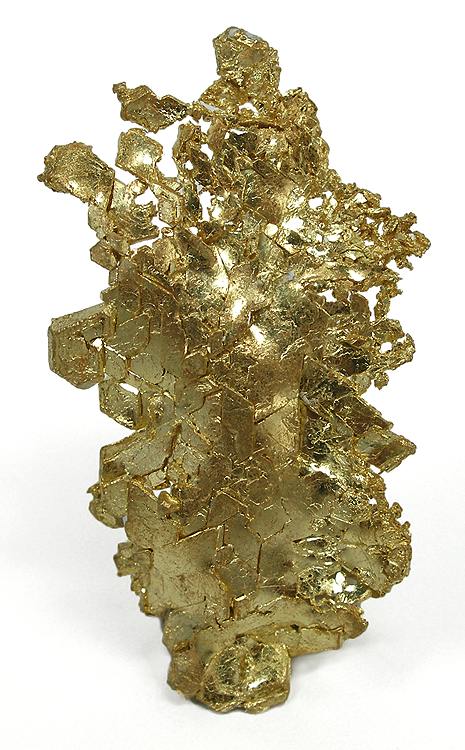
Native Gold
Oro Nativo
Au Properties
- Category
- Mineral
Native gold is the pure precious metal found in nature in its elemental state, uncombined with other elements. It forms characteristic yellow cubic crystals and represents the most prized and readily workable form of gold for jewelry and investment purposes.
Native gold (Au) is a mineral of exceptional economic and historical importance, belonging to the cubic crystal system with a crystalline habit often octahedral or cubic, though more frequently found in massive, lamellar, or flake forms. Its hardness of 2.5–3 on the Mohs scale makes it relatively soft, but its extraordinary ductility and malleability have made it the preferred metal for artisanal working since antiquity. Native gold forms primarily in hydrothermal environments associated with quartz, pyrite, and chalcopyrite, often in auriferous veins linked to acidic igneous rocks. Secondarily, it concentrates in alluvial and colluvial deposits through erosion and mechanical transport, where its high density (19.3 g/cm³) favors accumulation in heavy sediments. The most historically celebrated deposits include California's rivers during the 1849 Gold Rush, but currently the principal producers are China, Australia, Russia, and Canada, with superior gemological quality sourced from Australia and East Africa.
Native gold — Au, cubic crystal system (space group Fm3̄m), lattice parameter a = 4.078 Å. Density: 19.30 g/cm³; Mohs hardness 2.5–3; cleavage absent; fracture irregular. Brilliant metallic luster; characteristic yellow color (absorption wavelength 480–520 nm). Exceptional electrical and thermal conductivity (σ ≈ 4.1 × 10⁷ S/m). Complex refractive index: n = 0.47 + 3.01i at λ = 589 nm (sodium D lines). Raman spectroscopy shows characteristic bands at 217 cm⁻¹ (lattice vibrations). Magnetism: diamagnetic (χ = −3.6 × 10⁻⁵ emu/g). Melting point: 1064 °C. Soluble in aqua regia (HNO₃:HCl 1:3). Typical mineralogical associations: quartz, pyrite (FeS₂), chalcopyrite (CuFeS₂), galena (PbS), sphalerite (ZnS). Genesis: primary deposits in mesozonale hydrothermal veins (200–600 °C); secondary deposits in placers and laterites. Quantitative chemical analysis: commercial purity 99.99% Au (fine gold); traces of Ag, Cu, Fe reduce value. Electron microprobe analysis (EPMA) enables determination of trace elements (ppm).
Mining localities
- Klondike, Yukon, Canada — depositi alluvionali storici, pagliuzze e pepite
- Victoria, Australia — vene primarie in graniti e scisti, qualità gemmologica superiore
- Witwatersrand, Sudafrica — giaciture aurifere mesozoali associate a conglomerati
- Carlin Trend, Nevada, USA — depositi in rocce sedimentarie carbonatiche, oro microscopico
- Tiomin, Russia (Siberia) — oro in placers e vene idrotermali
- Ghiacciaio Furka, Svizzera — oro glaciale in sedimenti quaternari
Frequently Asked Questions
How can you identify real native gold from other pyrite or yellow minerals?
Native gold is extremely malleable and leaves no white or gray streaks when rubbed on porous ceramic, while pyrite is brittle and produces sparks. Pure gold (Au) has a density of 19.3 g/cm³, much higher than any other yellow mineral, making it noticeably heavy despite small sizes.
Where is native gold found in nature and in what types of rocks?
Native gold deposits mainly in quartz veins associated with metamorphic and igneous rocks, and frequently in alluvial sediments from river zones where it concentrates through erosion. The world's richest areas are California, Australia, Siberia and some Alpine regions, where tectonic movements have brought gold up from Earth's depths.
What is the price of native gold per gram and how does it vary?
Native gold price follows the daily spot price of gold on international markets (London Bullion Market), currently around 60-70 euros per gram, fluctuating due to currency movements and global demand. Pure native gold trades at minimal premium over refined gold since its purity (Au 99.9%) is already verifiable and requires no further processing.
How does native gold form in rocks and what is the geological process?
Native gold forms primarily through hydrothermal precipitation when Au-rich waters circulate through rock fractures at high temperatures and pressures, depositing in quartz or feldspar veins. A second process occurs through mechanical concentration in alluvial environments, where denser gold accumulates in sandy layers during river transport, creating placer gold deposits (coarse gold).
Entry generated with Claude API (Anthropic) on data extracted from Mindat, RRUFF and Wikipedia. Not yet reviewed by a human expert. Verify data against original sources before citing in formal work.