Pyromorphite
Piromorfite
Pb₅(PO₄)₃Cl Properties
- Category
- Mineral
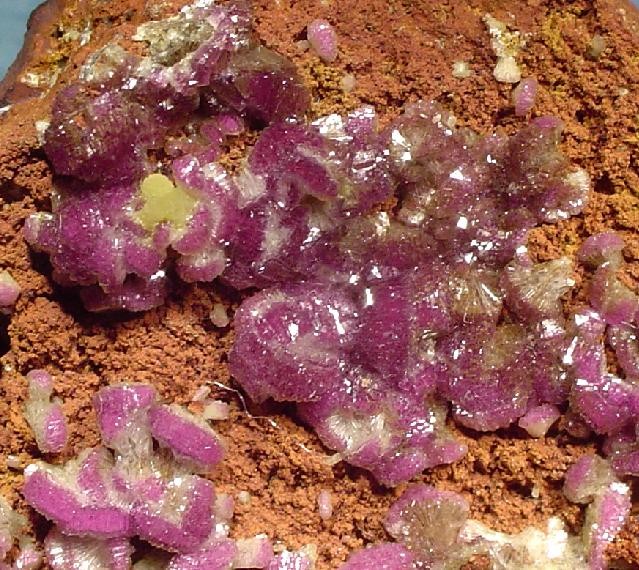
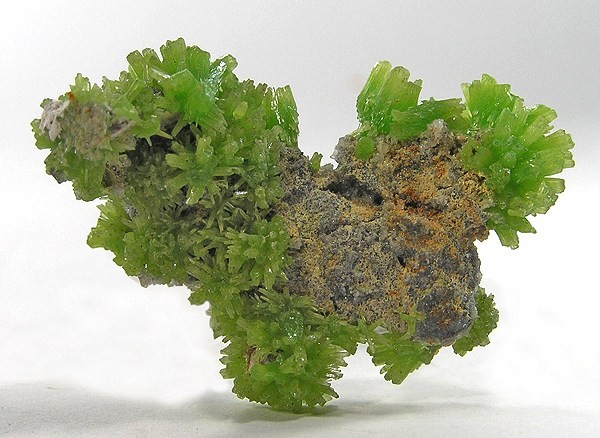
Pyromorphite is a lead and chlorine phosphate that crystallizes in elongated hexagonal forms, often brilliant green or yellowish-brown, and represents one of the most common alteration minerals in the oxidized zones of lead deposits.
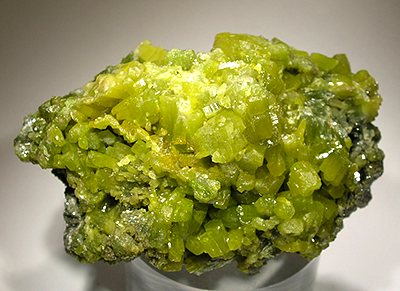
Pyromorphite (Pb₅(PO₄)₃Cl) is a secondary phosphate that forms in the supergene environment, that is, in the oxidized zone of lead deposits, where phosphate-rich percolating solutions interact with primary lead minerals such as galena. Its name, coined in 1832, derives from the Greek pyr (fire) and morphe (form), because the fused crystals assume characteristic shapes. It crystallizes in the hexagonal system with an elongated prismatic habit, sometimes with pointed terminations, and displays a remarkable chromatic variety: from emerald green to canary yellow, from brown to gray, depending on impurities and the degree of oxidation.
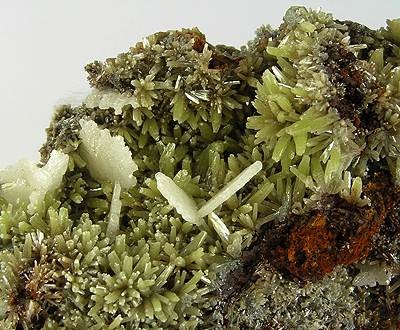
Pyromorphite crystals are appreciated by mineral collectors for their beauty and clarity. It often associates with other secondary phosphates such as apatite and vivianite, as well as with lead oxides and carbonates. Its relatively low hardness (3.5–4 on the Mohs scale) and brittleness make it fragile for cutting, but transparent specimens are sometimes faceted as gemological curiosities. The most renowned localities for exceptional crystals include Leadhills in Scotland, Erzgebirge in Germany, Ojuela Mine in Mexico, and various historic mines in Cornwall.
Pyromorphite — Pb₅(PO₄)₃Cl. Crystal system: hexagonal, space group P6₃/m, lattice parameters a ≈ 10.0 Å, c ≈ 7.4 Å. Habit: hexagonal prismatic, often with combined forms (1010), (0001). Hardness: 3.5–4 Mohs; cleavage: absent; fracture: conchoidal to irregular. Density: 7.0–7.1 g/cm³. Luster: vitreous to resinous; transparency: transparent to translucent. Color: emerald green, yellow, brown, gray; streak: white. Refractive index: nω ≈ 2.058, nε ≈ 2.048 (negative birefringent). Spectroscopic absorption: characteristic bands in the visible range for green specimens due to traces of metal ions. Solubility: slightly soluble in dilute acids. Genesis: typical supergene mineral of oxidized zones in lead deposits, often associated with cerussite, anglesite, malachite, azurite. Varieties: the isomorphous series with apatite (Pb₅(PO₄)₃F, Pb₅(PO₄)₃OH) is known as the apatite group. Fluorescence: under long-wave UV, occasionally weakly fluorescent (yellow-green). Thermal stability: stable up to approximately 400 °C; dehydration and decomposition at higher temperatures.
Mining localities
- Leadhills, South Lanarkshire, Scozia, Regno Unito
- Erzgebirge (Monti Metalliferi), Sassonia, Germania
- Mina Ojuela, Mapimí, Durango, Messico
- Mina di Wheal Phoenix, Cornovaglia, Inghilterra
- Mina di Tarnowitz, Slesia, Polonia
- Mina di Langban, Värmland, Svezia
- Mina di Tsumeb, Namibia
- Mina di Broken Hill, Nuovo Galles del Sud, Australia
Frequently Asked Questions
How does pyromorphite form and in which environments is it found?
Pyromorphite forms primarily in oxidized zones (gossans) of lead deposits, where phosphate-rich waters alter primary lead minerals such as galena. It represents an advanced stage of oxidation and is particularly common in temperate climates where meteoric water promotes supergene alteration of mineral deposits.
How to recognize pyromorphite by its appearance and physical characteristics?
Pyromorphite is recognizable by its characteristic elongated hexagonal crystals (needle-like) in bright green, yellowish-brown or rarely white colors, with resinous luster and variable transparency. Its hardness is low (3.5-4 on the Mohs scale) and density is high (about 7.0 g/cm³), properties typical of lead phosphates.
What is the chemical formula of pyromorphite and which elements does it contain?
The chemical formula of pyromorphite is Pb₅(PO₄)₃Cl, indicating that it contains lead, phosphorus, oxygen, and chlorine in specific proportions. Lead constitutes about 82% of the weight composition, while chlorine can sometimes be partially replaced by hydroxyl or fluoride ions, creating structural varieties.
Where can I find pyromorphite and what is its value on the collectors' market?
Pyromorphite is found in lead deposits worldwide, with notable locations in Morocco, Sweden, Germany, and the United States (especially Pennsylvania). Collectible-quality crystals generally cost between 5 and 50 euros per specimen, while exceptional samples with well-formed crystals and vivid colors can reach significantly higher prices among mineral collectors.
Entry generated with Claude API (Anthropic) on data extracted from Mindat, RRUFF and Wikipedia. Not yet reviewed by a human expert. Verify data against original sources before citing in formal work.