Celestite
Celestina
SrSO₄ Properties
- Category
- Mineral
Celestite is a strontium sulfate (SrSO₄) that crystallizes in orthorhombic forms, often colorless or blue, and represents the primary industrial source of strontium for pyrotechnic and chemical applications.
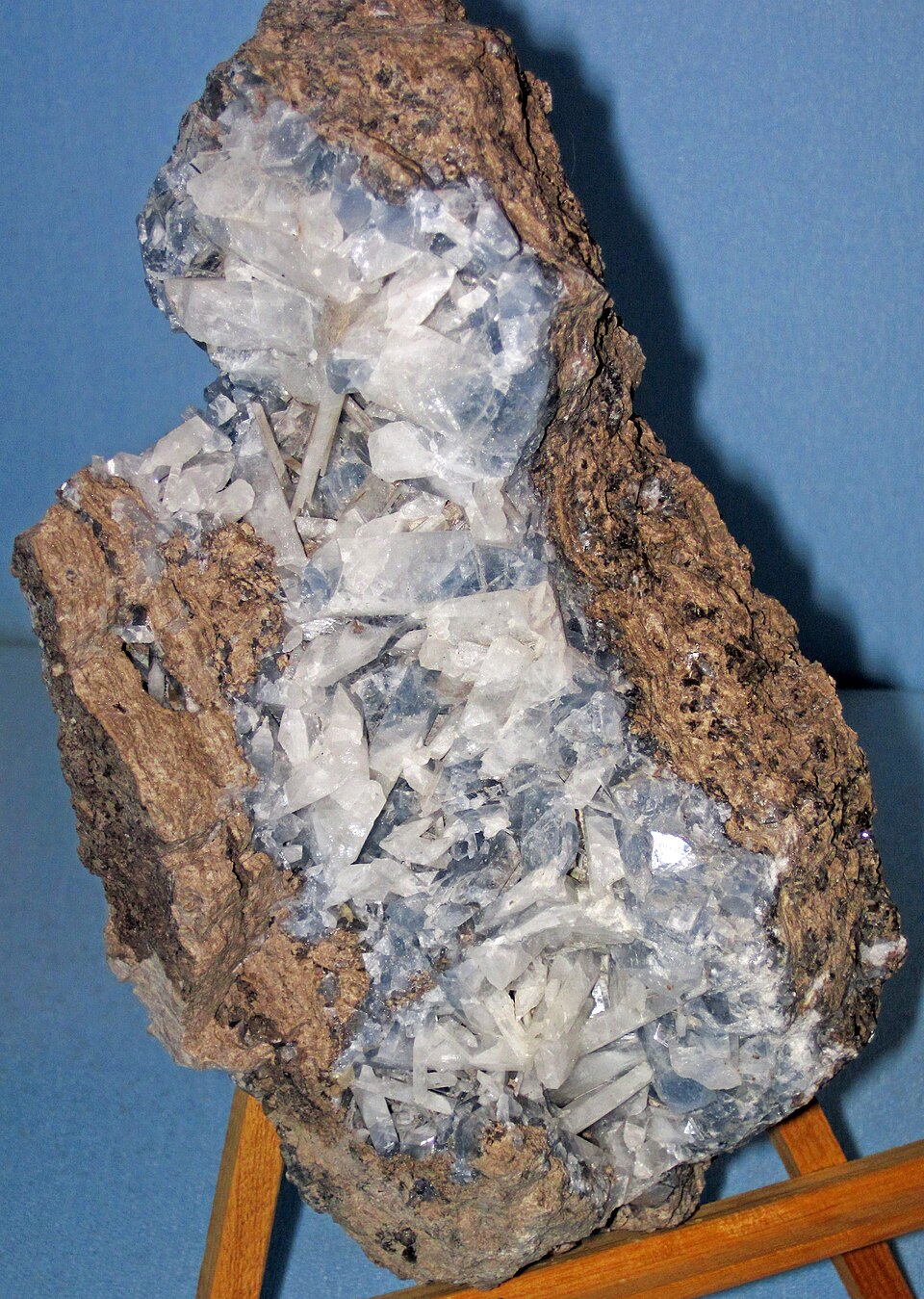
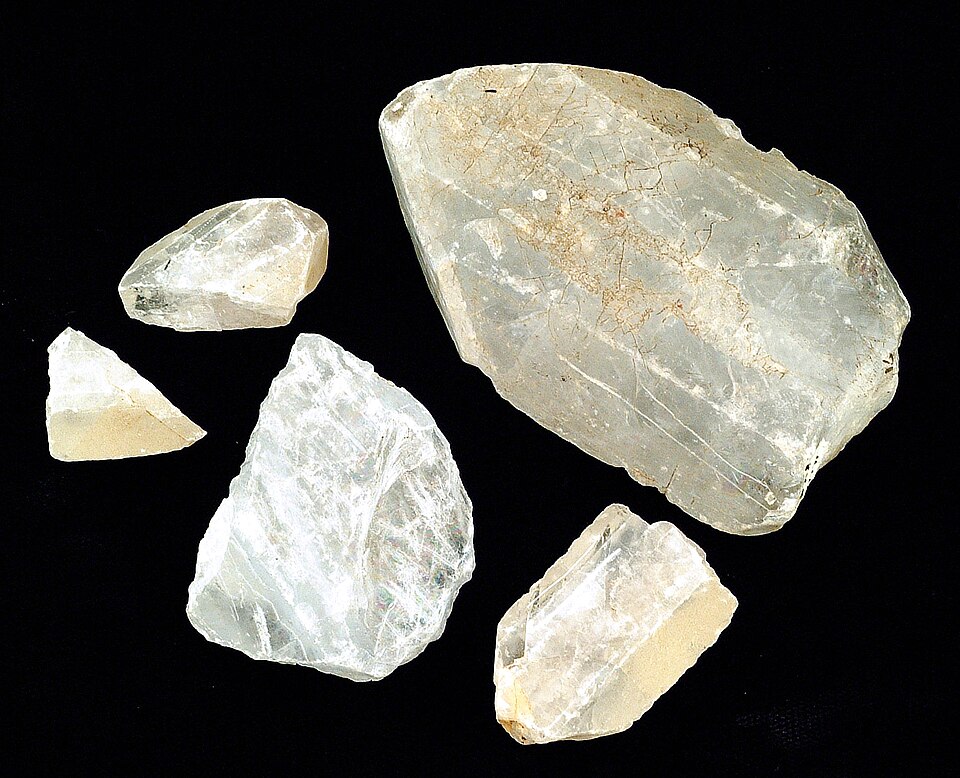
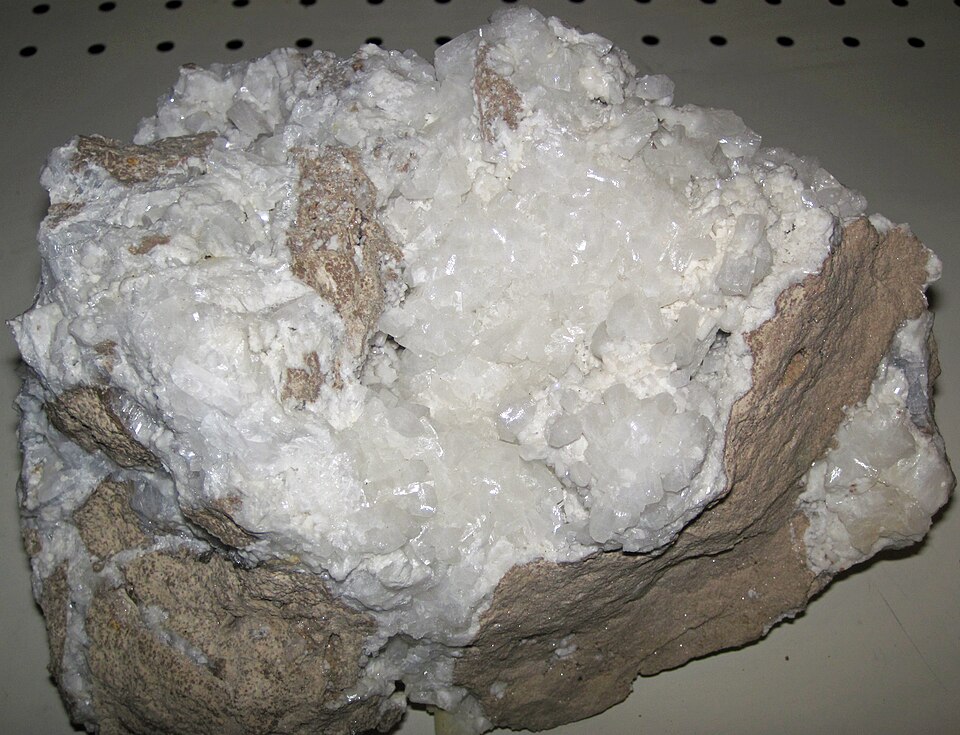
Celestite derives its name from the Latin *caelestis* (celestial) due to the characteristic blue color that distinguishes it. It forms predominantly in marine evaporitic environments, where elevated concentrations of strontium and sulfate ions precipitate slowly in confined basins. It crystallizes in the orthorhombic system with an elongated prismatic habit; the finest crystals prized by collectors come from deposits in Ohio and Pennsylvania (USA), where they reach exceptional dimensions and crystalline transparency. Frequently associated with halite, gypsum, and rock salt, celestite reveals the geological history of ancient evaporated seas. Its moderate hardness (3–3.5 on the Mohs scale) renders it fragile but ideal for optical and diffractometric studies. From an industrial perspective, it is extracted on a massive scale to obtain strontium compounds destined for red fireworks, radiological shielding, and chemical catalysts.
Crystal system: orthorhombic, space group *Pnma*. Unit cell parameters: a = 8.359 Å, b = 5.352 Å, c = 6.866 Å. Calculated density: 3.97 g/cm³. Mohs hardness: 3–3.5; perfect cleavage along (001), good cleavage along (210). Refractive index: nα = 1.619, nβ = 1.623, nγ = 1.631 (birefringence ≈ 0.012). Pleochroism absent or very weak. Raman spectroscopy: characteristic peaks at 987 cm⁻¹ (SO₄ stretching) and 452 cm⁻¹ (bending). IR spectroscopy: intense absorptions at 1,130–1,000 cm⁻¹ (ν₃ SO₄) and 610 cm⁻¹ (ν₄ SO₄). UV fluorescence: occasionally blue-violet under 254 nm radiation. Solubility: slightly soluble in water (2.4 g/L at 20°C); soluble in dilute acids. Crystal structure isomorphous with barite (BaSO₄) and anglesite (PbSO₄), belonging to the orthorhombic sulfate family. Typical paragenesis: halite, gypsum, rock salt, dolomite, calcite in diagenetic and evaporitic environments.
Mining localities
- Ohio, Pennsylvania (USA) — esemplari di qualità gemmologica con cristalli trasparenti fino a 15 cm
- Madagascar — celestina azzurra di eccellente purezza da depositi evaporitici
- Inghilterra (Cotswolds) — cristalli associati a gesso in formazioni mesozoiche
- Sardegna, Italia — celestina in paragenesi con fluorite e calcite in ambienti filoniani
- Messico (Coahuila) — depositi massivi sfruttati industrialmente
- Tunisia — celestina in giacimenti evaporitici terziari
Frequently Asked Questions
How much does celestine cost and where can you buy it?
Celestite of collector quality typically costs between 10 and 50 euros per kilogram depending on purity and crystal size, while raw extracted specimens are less expensive. It is available from online mineral retailers, natural history museums, and specialty mineral shops, or directly from industrial suppliers for commercial strontium applications.
How to recognize genuine celestite from other blue stones?
Authentic celestite has a hardness of 3-3.5 on the Mohs scale (softer than sapphire) and is a strontium sulfate (SrSO₄) displaying orthorhombic crystals with vitreous luster. For certain identification, dilute hydrochloric acid will not produce effervescence (unlike calcite), and its density of approximately 3.97 g/cm³ is higher than quartz, which helps distinguish it.
What are the main industrial applications of celestite?
Celestite is the primary source of industrial strontium, primarily used in the production of fireworks and rockets where strontium generates the characteristic bright red color. Other significant applications include the production of specialty glasses, pigments, paper fillers and chemical industry products, as well as strontium ion battery manufacturing.
How does celestite form in nature and where is it found?
Celestite (SrSO₄) forms primarily in evaporitic and sedimentary environments, associated with aragonite and halite when strontium and sulfate-rich solutions undergo evaporation in closed basins. Major world deposits are found in Mexico, Madagascar, England, Ohio (USA), and Pakistan, often within deposits of evaporated marine salts.
Entry generated with Claude API (Anthropic) on data extracted from Mindat, RRUFF and Wikipedia. Not yet reviewed by a human expert. Verify data against original sources before citing in formal work.