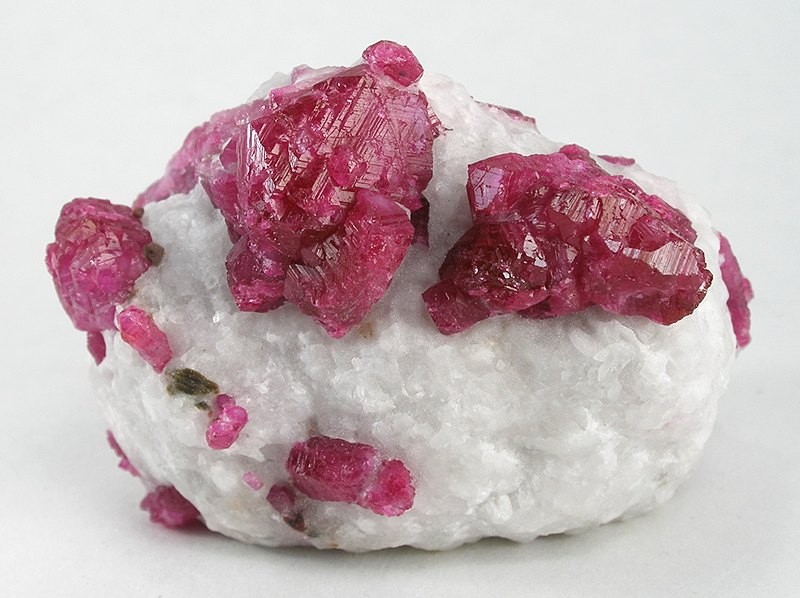
Marble
Marmo
CaCO₃ Properties
- Category
- Rock
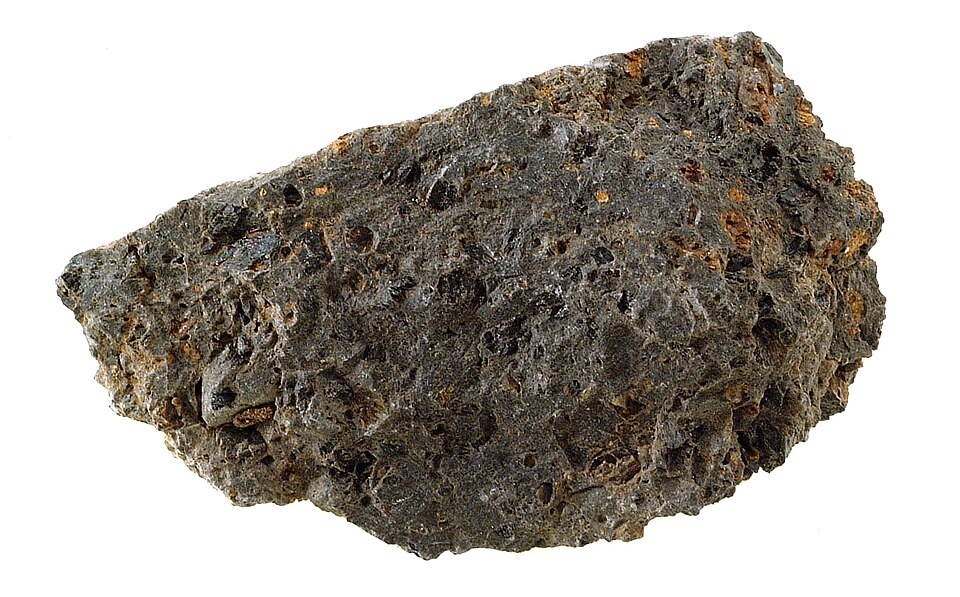
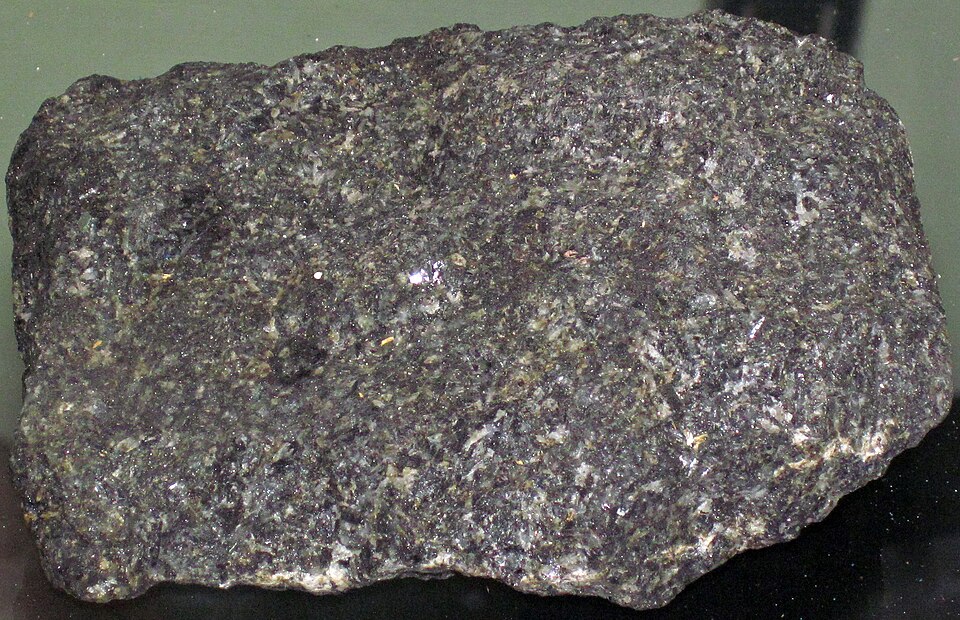
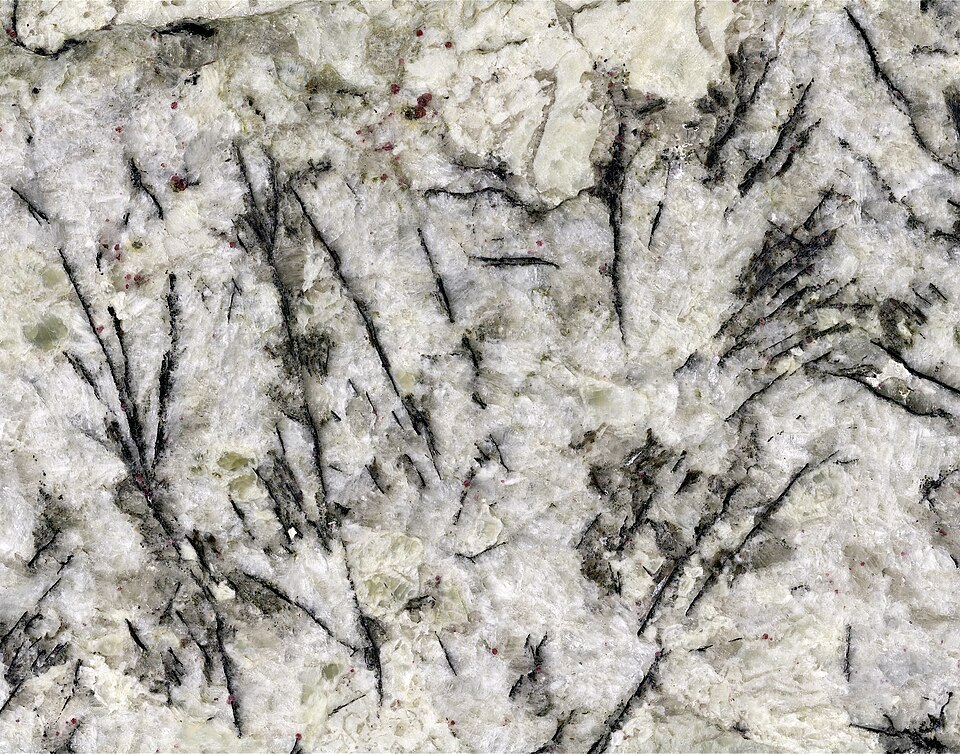
Marble is a metamorphic rock composed primarily of calcite (CaCO₃) crystals, formed by the metamorphism of limestone or dolomite under elevated pressure and temperature. Characterized by a compact crystalline structure and often by colored veining, it has been the preferred material of sculptors and architects since antiquity for its workability and beauty.
Marble forms when limestone or dolomite, sedimentary rocks rich in calcium carbonate, undergo regional metamorphism during orogenic processes. Under pressures of 2–5 kbar and temperatures between 200 and 800 °C, calcite crystals recrystallize into larger and more homogeneous aggregates, eliminating original impurities and imparting marble with its characteristic granular structure. Recrystallization obliterates original sedimentary structures, transforming the material into a massive and compact rock.
Marble varieties vary enormously in color and composition depending on impurities present in the original limestone. Pure white marble, such as Carrara marble, contains nearly pure calcite; gray, pink, or red marbles derive from inclusions of graphite, iron oxides, or silicate minerals such as quartz, feldspar, and mica. Common mineral associations include dolomite, talc, tremolite, and forsterite, which impart distinctive mechanical and chromatic characteristics. From an economic perspective, marble represents one of the most valuable ornamental stones, with historic deposits in Italy (Carrara, Tuscany), Greece (Thassos), Turkey (Afyon), and China, where quality and color determine commercial value.
Marble is a medium to fine-grained metamorphic rock composed primarily of trigonal calcite (CaCO₃) with rhombohedral crystal structure. Mohs hardness 3–4; density 2.7–2.8 g/cm³. Ordinary refractive index (no) approximately 1.658; extraordinary refractive index (ne) approximately 1.486; positive birefringence Δn ≈ 0.172. Solubility in dilute HCl at room temperature with pronounced effervescence, characteristic of calcite.
Crystal structure: trigonal, space group R3c, lattice parameters a ≈ 4.99 Å, c ≈ 17.06 Å. Metamorphic recrystallization produces xenomorphic aggregates with irregular contacts (granoblastic texture); the degree of metamorphism determines mean crystal size (0.1–10 mm). Raman spectroscopy shows characteristic CaCO₃ peaks at 1086 cm⁻¹ (symmetric CO₃²⁻ stretching), 1435 cm⁻¹ (asymmetric stretching), 713 cm⁻¹ (in-plane bending), and 879 cm⁻¹ (out-of-plane bending).
Varieties containing dolomite CaMg(CO₃)₂ exhibit intermediate compositions and slightly different physical properties. Silicate marbles contain accessory minerals such as tremolite Ca₂Mg₅Si₈O₂₂(OH)₂, quartz SiO₂, and feldspar, which increase hardness and resistance to alteration. Coloration derives from trace elements: Fe²⁺/Fe³⁺ for gray and red tones, Mn²⁺ for pink, graphite for black. UV-Vis spectroscopic absorption reveals characteristic bands dependent on impurity composition.
Mining localities
- Carrara, Toscana, Italia
- Thassos, Grecia
- Afyon, Turchia
- Verona, Veneto, Italia
- Yule, Colorado, Stati Uniti
- Makrana, Rajasthan, India
- Paro, Bhutan
- Guangxi, Cina
Frequently Asked Questions
How is marble formed and what is its chemical composition?
Marble forms from the metamorphism of carbonate rocks (limestone or dolomite) subjected to high pressures and temperatures deep underground. It is primarily composed of crystallized calcite (CaCO₃), which recrystallizes during the metamorphic process, creating a compact and uniform crystalline structure.
How can you identify real marble from other rocks and synthetic materials?
Real marble exhibits a visible crystalline structure with a compact and uniform grain, and often contains natural colored veins from mineral impurities. A simple test is to apply vinegar to the surface: authentic marble will slightly effervesce due to the chemical reaction between acetic acid and calcium carbonate.
What are the main physical properties and advantages of marble as a building material?
Marble is valued for its hardness, compactness, and low porosity, along with its elegant aesthetic and unique natural veining. However, it is sensitive to acids and corrosive agents, requiring regular maintenance, and it is relatively more fragile than granite since calcite is softer than silicate minerals.
What are the main marble deposits in the world and the most famous commercial names?
The most important deposits are found in Italy (Carrara in Tuscany), Turkey, Spain, Portugal, and China, with Italian marble considered the most prestigious. Famous commercial names include Carrara white marble, Belgian black marble, Verona red marble, and Calacatta marble, each with distinctive characteristics and veining patterns.
Entry generated with Claude API (Anthropic) on data extracted from Mindat, RRUFF and Wikipedia. Not yet reviewed by a human expert. Verify data against original sources before citing in formal work.