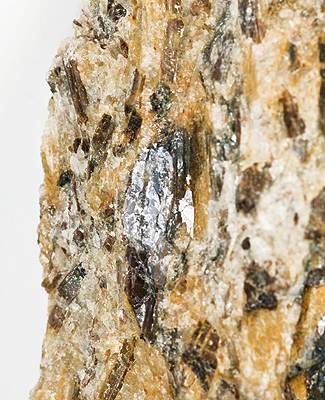
Sillimanite
Sillimanite
Al₂SiO₅ Properties
- Category
- Mineral
Sillimanite is an aluminum and silicon mineral (Al₂SiO₅) that forms in high-temperature metamorphic rocks, characterized by prismatic crystals that are often fibrous and a hardness of 6.5-7.5 on the Mohs scale. It is one of three polymorphs of aluminum silicate alongside kyanite and andalusite, and represents a valuable geological indicator of metamorphic conditions.
Sillimanite is an *aluminum silicate* belonging to the feldspathoid group, with chemical formula Al₂SiO₅. It crystallizes in the *orthorhombic system* (space group Pbnm) and typically presents in elongated prismatic crystals, often fibrous or matted (*fibrolite*), with color ranging from colorless to gray, brown, or bluish. Its genesis is strictly linked to *regional metamorphism* of pelitic rocks (schists and gneisses) subjected to temperatures exceeding 700 °C; it is frequent in *migmatitic rocks* and high-pressure gneisses. Together with kyanite and andalusite, sillimanite represents a *polymorph* of the same chemical compound, but stable at higher temperatures: this relationship is fundamental in *geothermobarometry*, as the sillimanite-kyanite transition indicates the attainment of high-grade metamorphic conditions. It frequently associates with feldspar, quartz, biotite, and corundum. Although not a precious gemstone, transparent and well-crystallized specimens have collectible value. Its hardness of 6.5-7.5 makes it brittle for jewelry use.
Crystallographic data: Orthorhombic system, space group Pbnm (no. 62), typical lattice parameters: a ≈ 7.48 Å, b ≈ 7.68 Å, c ≈ 2.93 Å. Physical properties: Hardness 6.5-7.5 Mohs; density 3.23-3.27 g/cm³; imperfect cleavage along (10); vitreous to silky luster; transparency ranging from transparent to translucent. Refractive index: nα ≈ 1.657, nβ ≈ 1.660, nγ ≈ 1.677 (birefringence ~0.020, positive biaxial). Spectroscopy: Characteristic absorption in the visible range for colored samples (blue: Fe³⁺ bands at ~600 nm); Raman spectrum with characteristic Si-O bands around 200-1100 cm⁻¹. Chemical composition: Pure Al₂SiO₅; common traces of Fe, Ti, Cr causing coloration. Thermodynamic stability: Ternary Al₂SiO₅ phase diagram shows sillimanite-kyanite transition at ~600 °C at moderate pressures; sillimanite-andalusite transition at decreasing temperatures. Mineralogical associations: K-rich feldspar, quartz, biotite, corundum, garnet, staurolite in high-grade metamorphic rocks (amphibolite-granulite facies). Alteration: May alter to muscovite or feldspar under retrograde metamorphic conditions.
Mining localities
- Charnockite Belt, Sri Lanka (sillimanite fibrosa di qualità gemologica)
- Khasi Hills, Meghalaya, India (cristalli ben formati in gneiss)
- Bretagna, Francia (sillimanite in migmatiti)
- Baviera, Germania (associata a corindone in rocce metamorfiche)
- Provincia di Ontario, Canada (in scisti pelitici ad alto grado)
- Kyushu, Giappone (sillimanite in rocce di subduzione)
- Monti Urali, Russia (in gneiss granulitici)
Frequently Asked Questions
What is the difference between sillimanite, kyanite, and andalusite?
Sillimanite, kyanite, and andalusite are three polymorphs of aluminosilicate (Al₂SiO₅) that differ in crystal structure and formation conditions. Sillimanite forms at higher temperatures than the other two, characterized by prismatic crystals often with a fibrous habit and a hardness of 6.5-7.5 on the Mohs scale. While kyanite is more brittle and andalusite has a different structure, sillimanite is the most stable at high temperatures in metamorphic rocks.
How do you recognize sillimanite in the field or in a sample?
Sillimanite can be recognized primarily by its prismatic, elongated crystals, often with a fibrous appearance, in white, gray, or light brown colors. A distinctive characteristic is its relatively high hardness (6.5-7.5 on the Mohs scale) and its association with other high-temperature metamorphic rocks such as gneiss and migmatites. Additionally, sillimanite exhibits imperfect cleavage and vitreous luster that aid in identification.
Where is sillimanite found and what are the main worldwide deposits?
Sillimanite is found primarily in high-temperature metamorphic rocks in various parts of the world, with significant deposits in India, Sri Lanka, Brazil, South Africa, and the United States. These minerals form in regional metamorphic areas, often associated with ancient metamorphic terrains or orogenic zones. India and Sri Lanka are the world's largest producers, where sillimanite is extracted along with other aluminum minerals for industrial applications.
At what temperatures and pressures does sillimanite form?
Sillimanite typically forms at temperatures above 600-700°C in regional metamorphic rocks, often at moderate-to-high pressures during high-grade metamorphism. Unlike kyanite, which forms at higher pressures, sillimanite is the stable phase of aluminosilicate at elevated temperatures and is common in gneisses and migmatites derived from feldspar-rich sedimentary rocks. Its presence is an important indicator of metamorphic grade and thermobarometric conditions of the metamorphic event.
Entry generated with Claude API (Anthropic) on data extracted from Mindat, RRUFF and Wikipedia. Not yet reviewed by a human expert. Verify data against original sources before citing in formal work.