Volcanic Tuff
Tufo Vulcanico
SiO₂ + Al₂O₃ + ossidi Properties
- Category
- Rock
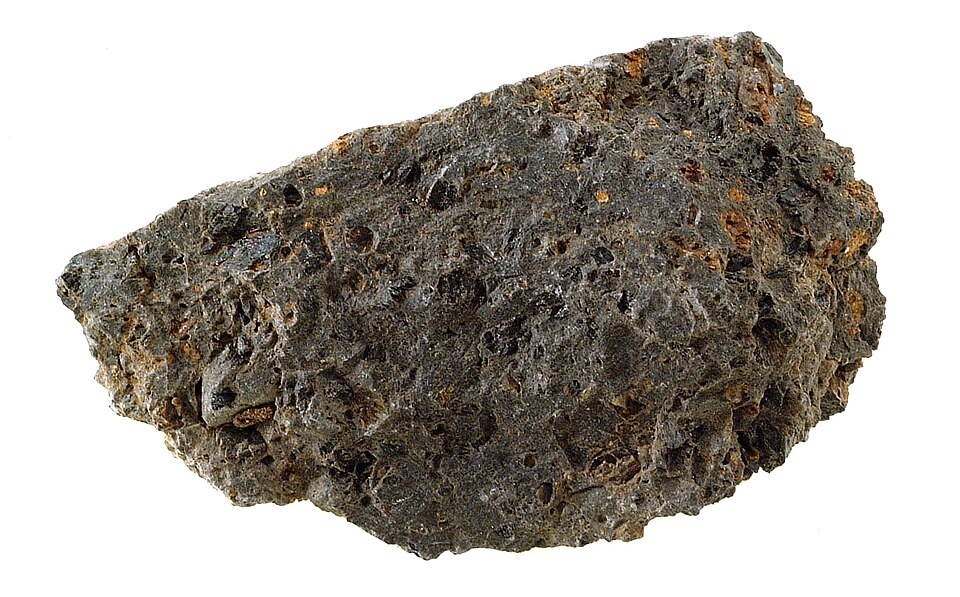
Volcanic tuff is a pyroclastic rock formed by the accumulation and cementation of volcanic fragments (ash, pumice, lapilli) expelled during explosive eruptions; characterized by low density, high porosity, and variable hardness (1-3 Mohs), it has been used since antiquity as a building material for its workability and insulating properties.
Volcanic tuff represents one of the most important products of explosive volcanic activity. It forms when pyroclastic material of various grain sizes—from fine ash (less than 2 mm) to lapilli and volcanic bombs—is expelled violently and deposited in successive layers. Cementation occurs through processes of compaction, diagenesis, and sometimes recrystallization of zeolitic minerals. Composition varies considerably according to the parental magma: basaltic, andesitic-basaltic, and rhyolitic tuffs present different proportions of silica, alumina, and oxides of iron and magnesium.
Historically, tuff played an extraordinary role in architecture and urban planning. The Etruscans and Romans preferred it for temples, amphitheaters, and civic dwellings: Rome itself was built largely on tuff, as were Naples and other Campanian cities that benefited from the tuffaceous deposits of the Phlegraean Fields and Vesuvius volcanic areas. Its relative ease of extraction and workability, combined with thermal and acoustic insulation properties, make it still a sought-after material in biobuilding. From a mineralogical standpoint, tuff may contain feldspars, quartz, micas, magnetite, and frequently secondary zeolites (mordenite, clinoptilolite) that confer absorptive and filtering properties.
Volcanic tuff is a consolidated pyroclastic rock, amorphous in the sense that it lacks ordered crystalline structure at the macroscopic scale, although it contains crystals of primary and secondary minerals. Apparent density typically varies between 1.4 and 2.0 g/cm³, significantly lower than that of massive volcanic rocks, due to porosity reaching 30-60% by volume. The Mohs hardness of 1-3 reflects the friable nature of the cementing matrix and the weakness of contacts between fragments. Average chemical composition (SiO₂ 55-75%, Al₂O₃ 10-18%, Fe₂O₃ + FeO 3-8%, CaO 2-5%, Na₂O + K₂O 3-8%) depends on the parental magma and degree of alteration. Water absorption is high (15-30% by weight), a property exploited in filtration and purification applications. The refractive index of glassy components varies between 1.50 and 1.55. Microscopically, tuff exhibits a glassy or microcrystalline matrix containing crystal fragments (alkali feldspars, plagioclase, quartz), volcanic rock fragments, and occasionally pumice and magnetite. Secondary zeolites, common in diagenetically altered tuffs, have refractive indices between 1.47 and 1.50. Interconnected porosity facilitates permeability to gas and fluids, with permeability coefficients ranging from 10⁻¹⁵ to 10⁻¹² m².
Mining localities
- Campania, Italia (Campi Flegrei, area vesuviana)
- Lazio, Italia (tufi albani, tufi del Tevere)
- Toscana, Italia (tufi vulcanici della Val d'Orcia)
- Umbria, Italia (tufi orvietani)
- Cappadocia, Turchia
- Eifel, Germania
- Islanda
- Nuova Zelanda
- Giappone (Giallo di Izu)
- Messico (tufi di Teotihuacan)
Frequently Asked Questions
How is volcanic tuff formed and what is the difference with other volcanic rocks?
Volcanic tuff forms from the accumulation and cementation of pyroclastic fragments (ash, pumice, and lapilli) expelled during explosive eruptions, unlike lavas that solidify from fluid magma. Its composition varies with SiO₂ and Al₂O₃ plus iron and magnesium oxides, giving it much lower density than basalt or granite. The high porosity and fragile structure make it a unique pyroclastic rock.
How do you identify volcanic tuff and what are its main characteristics?
Volcanic tuff is recognized by its low density (easily floats in water if highly porous), variable color from gray to reddish-brown, and visible volcanic fragments to the naked eye or magnifying glass. Its Mohs hardness of 1-3 makes it easily scratched and brittle, with such high porosity that it rapidly absorbs liquids. The structure is characteristically friable and disintegrates easily under tools.
Where is volcanic tuff found and what are the major deposits worldwide?
Volcanic tuff is found predominantly in active and recent volcanic zones, with significant deposits in Italy (Campania, Lazio, Tuscany), Germany, Turkey, Mexico, and New Zealand. Central Italy is particularly rich, especially around Vesuvius, Campi Flegrei, and the Roman area, where it has been quarried since Etruscan times. The most important deposits are associated with explosive eruptions of large volcanoes in the past few million years.
What is volcanic tuff used for today and what are its practical applications?
Volcanic tuff is mainly used as a building material for facades, flooring, and restoration of historic buildings due to its workability and aesthetic appeal. Its high porosity makes it ideal for filtration, thermal and acoustic insulation, and as a substrate in agriculture and landscaping. Additionally, thanks to its composition rich in SiO₂ and Al₂O₃, it is used in industry as a cementitious additive and in environmental applications for water remediation.
Entry generated with Claude API (Anthropic) on data extracted from Mindat, RRUFF and Wikipedia. Not yet reviewed by a human expert. Verify data against original sources before citing in formal work.