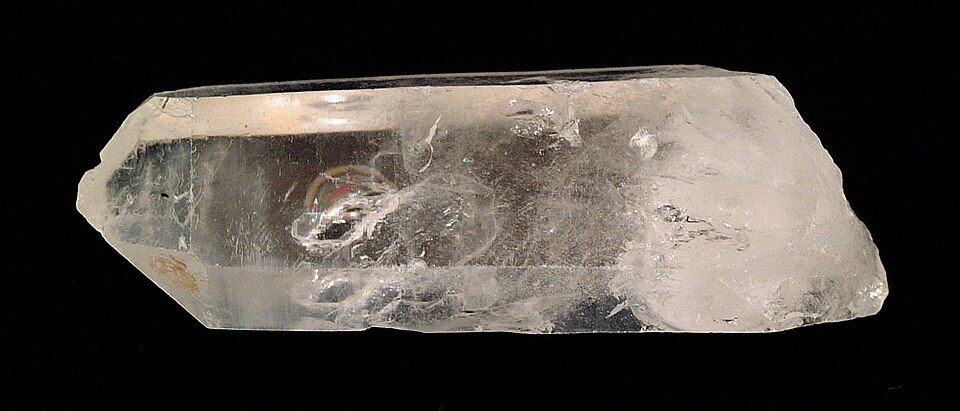
Rock Crystal
Quarzo Ialino
SiO₂ Properties
- Category
- Mineral
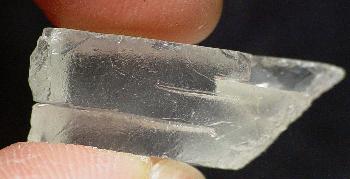
Hyaline quartz, also known as rock crystal, is a transparent and colorless variety of silicon dioxide (SiO₂) that forms magnificent prismatic crystals. It is one of the most abundant minerals on Earth, and its hardness of 7 on the Mohs scale makes it ideal for industrial and gemological applications.
Hyaline quartz is the purest and most transparent form of quartz, belonging to the trigonal crystal system. It forms in highly diverse geological environments: in granitic pegmatites, in low- to medium-temperature hydrothermal veins, and as a detrital component in sedimentary rocks. Its crystalline transparency depends on the near-total absence of inclusions and lattice defects. Historically, rock crystal has been appreciated since antiquity for its beauty and workability: the ancient Romans believed it to be eternal ice, while in the Middle Ages it was used for divination spheres and liturgical objects. Today it remains a popular gem in the market, with superior quality specimens sourced from Brazil, Madagascar, and Switzerland (particularly from the Gotthard Valley). Its density of 2.65 g/cm³ and the absence of pleochroism distinguish it from other transparent colorless gemstones.
Crystal system: trigonal (space group P3₁21 or P3₂21). Lattice parameters: a = 4.913 Å, c = 5.405 Å. Hardness: 7 Mohs; characteristic conchoidal fracture. Density: 2.648–2.660 g/cm³. Refractive index: nω = 1.543, nε = 1.553 (positive uniaxial birefringent, Δn ≈ 0.009). Chromatic dispersion: very low (0.013). UV spectroscopy: weak or absent fluorescence in UV-A and UV-C light; some varieties exhibit triboluminescence. Absorption: band at 350 nm (Fe³⁺) in traces. Chemical composition: pure SiO₂; traces of Al, Fe, Ti, Li may cause coloration. Formation: precipitation from hydrothermal solutions at T = 100–400 °C; primary crystallization in granitic pegmatites; diagenetic recrystallization in sedimentary environments. Mineralogical associations: feldspar, mica, tourmaline, fluorite, calcite. Thermal stability: stable up to ~573 °C (α→β-quartz transition). Solubility: insoluble in common acids at room temperature; soluble in concentrated HF. Gemology: Class IV gem according to Gubelin; transparency and clarity are primary evaluation parameters; rutile inclusions (golden needles) or chlorite impart collector interest.
Mining localities
- Vallese, Svizzera (Valle di Gottardo, Cristallina)
- Minas Gerais, Brasile (pegmatiti)
- Madagascar (Antananarivo, cristalli di grandi dimensioni)
- Piemonte, Italia (Val d'Aosta, Alpi)
- Alpi Apuane, Toscana, Italia
- Catena del Monte Bianco, Francia-Italia
- Quartz Peak, Arkansas, USA
- Dauphiné, Francia (giacimenti storici)
Frequently Asked Questions
How can you tell authentic rock crystal from other transparent crystals?
Rock crystal is recognized by its hardness of 7 on the Mohs scale, making it more scratch-resistant than glass and fluorite but softer than topaz. When examining the crystal structure, it displays characteristic hexagonal prismatic faces and often contains inclusions of other minerals or air bubbles, whereas glass has an amorphous and uniform structure. Its pure SiO₂ chemical composition distinguishes it chemically from other transparent minerals like smoky quartz or amethyst, which contain color-inducing impurities.
What are the main industrial applications of rock crystal?
Rock crystal is used in precision optics manufacturing, lenses, and prisms thanks to its transparency and piezoelectric properties, as well as in quartz watch production where its crystal structure generates stable electrical oscillations. It is also employed industrially for the fusion of specialty glasses, in semiconductor production, and as an abrasive in grinding and polishing applications. Its abundance on Earth makes it economically advantageous compared to other synthetic optical materials.
Where are the most important rock crystal deposits located worldwide?
The world's major rock crystal deposits are found in Brazil, which is the largest producer globally, followed by Madagascar, Arkansas (USA), and India, where high-quality crystals of significant size are extracted. The Alpago region in Italy, the Swiss Alps, and Japan also have significant deposits, though of lesser commercial importance, often characterized by crystals of notable mineralogical beauty. The formation of these deposits is linked to hydrothermal processes in pegmatite environments and quartz veins within crystalline rocks.
What is the difference between natural and synthetic rock crystal?
Natural rock crystal forms crystals over thousands of years through hydrothermal processes under specific geological conditions, featuring inclusions, crystalline defects, and a unique structure that reflects its geological history. Synthetic quartz, produced in laboratories through controlled hydrothermal growth or fusion, possesses superior purity, absence of inclusions, and more uniform physical properties, making it preferable for technical applications such as integrated circuits and precision optics. Both have identical SiO₂ chemical composition, but natural crystal retains higher collectible and mineralogical value.
Entry generated with Claude API (Anthropic) on data extracted from Mindat, RRUFF and Wikipedia. Not yet reviewed by a human expert. Verify data against original sources before citing in formal work.